
The 1923 Affair
At the Congress held in Geneva in August 1922, the Swiss delegate, Mr Jules Neher, FICM Vice-President, received congratulations from his colleagues for another victory in the International Six Days’ Trial – the third consecutive one. He thanked them and explained that the Union Motocycliste Suisse (UMS) was studying if they would apply once again for the organisation or would waive this right to do so and offer the organisation to another country. The idea was to hand it over to Sweden and Norway. At the following Congress in London in December 1922, the Swedish delegate, Mr Anderson, stated that the Svenska Motor Cycle Klub, in cooperation with the Norsk Motor Cycle Klub, gladly accepted the suggestion made by the UMS to organise the next International Six Days’ Trial in their countries. He said that “Sweden had a large experience in organizing such competitions and was therefore prepared to undertake such responsibility for organising the 1923 ISDT”. He explained that “the general conditions would be the same as those for the 1922 Trial, but that they would not propose to inflict any penalties for the conditions of the machines”. The proposals put forward were accepted by the General Council.
The spirit of the rules
The 1923 International Six Days’Trial was held from 6 to 12 August, with one day off on the 10th in Gothenburg. There were 94 riders taking part in the Six Days, of whom 23 retired. This was many more than the 23 entered riders in 1920 (of which 15 had taken the start). Riders came from six different countries: Sweden, Norway, Denmark, Great Britain, Belgium and Switzerland. In the Trophy team classification, Sweden finished in first position (with their three riders), Great Britain in second and Switzerland in third (both with two riders only). Various protests were lodged during the event, but none of them was accepted by the Jury.
The “affair” started when Mr Jules Neher took the floor at the Central Bureau meeting on 4 December 1923 during the Congress in Paris, in order to report facts that had been gathered from various eye-witness sources present during the Six Days. Neither the Swedish nor the Norwegian delegates were present at that Congress.
“The Swiss Motorcycle Union, although entitled to organize the Trial in the year 1923, decided to abandon its rights to the Swedish Motorcycle Union, in view of giving this important trial a greater international importance and interest”, said Neher. During the FICM Congress in London, the delegate of Sweden was not then in a position to present final, or even preliminary regulations, but he made a formal declaration that the 1923 regulations would in every point be in accordance with the regulations adopted for 1921/1922 with the only exception that the technical examination of the machines after the trial and the ensuing penalties for defects incurred during the trial would not be included. This innovation was adopted by the Congress.
When the preliminary regulations were issued, several of the articles were found insufficient and lacking in precision. This insufficiency was pointed out to the FICM by letter and was also discussed at the Dinant Congress on 16 July 1923. In view of the absence (once again) of any Swedish delegate, the Congress was not in a position to enter upon the subject, and further, it was supposed that final regulations would correct the deficiency of the preliminary regulations. However, when the final regulations were issued, it was noted - too late - that two of the most important conditions of the 1921/1922 regulations were simply omitted. They were 1: the obligation to follow the official course and 2: the obligation that all repairs have to be made exclusively by the competitor, and that the spare parts for such repairs should be exclusively carried on the motorcycle itself throughout the trial.
Essential rules omitted
The problem was, quite obviously, that these two omissions completely modified the character of the Trial to the unquestionable advantage of the home team, which was in a position to choose shorter or better roads than those marked out on the official course, and could also make use of all the means available for their repairs, means that were not accessible to the riders arriving from outside. The omissions of these rules were also in contradiction to the declarations made by the Swedish delegate during the London Congress in December 1922. In Stockholm just before the start, the organisers explained to the riders that on controlled hills Art. 22 of the regulations permitted competitors to touch the ground with their foot in case of wheel slip; such steadying would not carry a penalty as long as the engine was running. However, Swiss riders were penalised. Other complaints were mentioned, such as:
- Scandinavian riders were seen leaving the official course wherever they chose in order to follow easier roads.
- Cars equipped with full sets of spares and for repair work followed the Swedish teams and made all kinds of repairs during the Trial by means of workmen who were not themselves competitors.
- All test rides on the hill in Christiania were forbidden to foreign riders under penalty of disqualification.
- During the speed test, several machines were allowed to take off all their accessories, and therefore did not have their normal trial equipment. The other riders were not allowed similar unloading.
- In Norrköping, a 1000cc motorcycle was removed from the enclosure during the night and brought back at half past five in the morning – certified by an eye-witness.
- A controlled hill was eliminated on account of road repairs. This road was not under repair a few days before the Trial. This hill happens to be in the immediate neighbourhood of a motorcycle factory…
- On day 5, the motorcycle referred to above was not in running conditions and could scarcely ascend the slightest hill without the assistance of the passenger. On day 6, the same machine, on the kilometer test, achieved a speed of over 73 km/h. Neither the machine nor the number plates were sealed, an omission which would naturally permit the substitution of any defective part.
The end of the report requested that “for the future, complete and impartial regulations for International Trials should be established by the FICM; for each Trial an International Jury should be elected in accordance with the international teams entered and with an even number of members for each nation presenting a team; the results of the 1923 ISDT should not be approved by the FICM and the International Trophy should be returned to the FICM as this could not be attributed to the Swedish team, the riders of which were unjustly favoured; the FICM should express its disapproval to the organisers for having failed in their obligations of international impartiality”.
The Jury President
In fact, what came out from this meeting is the fact that good faith was not really respected. The target of the Six Days was also not respected. But FICM’s Secretary General Major Thomas Wynn Loughborough had officiated as Jury President in Sweden. He answered to the report commented on by Mr Neher by explaining that the rules were effectively lacking a number of points but that they were accepted by the competitors. Concerning the hill in Christiania, it was private property and no permission was granted for the Trial. As for the timekeeping, the methods employed were those in use in the country. The Jury was of the opinion that it was a poor sort of competition but that the Swedes had done their best and that the rules were not made to the special advantage of the Swedish competitors or otherwise. “In my sincere opinion the Trial was run in an impartial manner and the omission in the rules of a clause obliging competitors to follow the special route and preventing them from receiving outside assistance was very unfortunate, and probably operated in favour of the national team, but on the other hand, as the Trial took place under the printed rules accepted by the competitors, no protest can be admitted on these different points. I am of the opinion that the results have not been vitiated by the omission of these rules and that the Federation cannot go further than to express its regrets that its members who were invited to enter this Trial did not perceive those omissions until too late”.
Mr Neher took the floor again: “In the first place I should like to declare that we recognize that the reception of the competitors and the general organization of the Trial were above reproach. All these gentlemen are loudly to be praised as far as the general organization is concerned. Secondly I am sure that the Jury has carried out its duty, for it has applied the rules which were placed before it”.
Various delegates regretted that no Swedish delegate was present at this meeting. He could have provided explanations on the subject of these various protests. The problem, however, was not the results, but rather the moral results from the operation of the regulations to which attention should be directed. The route book issued to each competitor included an itinerary and a map; surely the competitor should unhesitatingly think that the official route must be followed – if not, only the actual controls should have been indicated. Mr Longuemare, the French delegate who was chairing the meeting, said: “We have before us very serious complaints. In this Trial fundamental principles have been violated and in the opinion of all present the original international regulations were a model for all regulations and it was impossible to omit any of them without disastrous results”. He then proposed to put it to the vote whether or not the Six Days’ organised by Sweden should be confirmed. By seven votes against, one in favour and two abstentions, the results of the 1923 ISDT were not approved.
One year later
It was not until the Congress held in Paris on 7 October 1924 – almost a year later and well after the 1924 ISDT held in Belgium -, that the matter could be discussed and, thanks to the presence of Swedish and Norwegian delegates, finally “settled”. The Svenska Motorcycle Klub (SMK), represented by Captain Nils Brambeck and Messrs de Lagerberg and Sven Dahlen, and the Norsk Motorcycle Klub (NMK) represented by Mr Eric Mathiesen, had received the report of the UMS and then sent their own report, answering the UMS document point by point.
The discussion in the general meeting started with Mr Loughborough reporting that “an emphatic objection had been lodged by the Swedish Association against the refusal of the Federation, following the objections lodged by the Swiss Association, to ratify the results of the 1923 ISDT”. The President (Count Bonacossa) had decided that the question must be re-opened. Mr Neher stated that he had seen the Swedish reply which he accepted without question. “The criticisms were made in all sincerity and were based on the fact that in the regulations two essential things were omitted. The objective was to ensure that in future Trials of this description the regulations shall be so framed that no suspicion of partiality can fall on either the promoters or the competitors”.
Mr de Lagerberg expressed the regret of the Norwegian and Swedish Associations in being prevented from attending the last Congress. A complete report on the Trial, replying to every objection that had been raised, was submitted to the Federation, and he requested that a précis of this report, made the Secretary General, should be read to the meeting.
Major T.W. Loughborough then read the report on the position of the SMK following the charges made by the UMS.
- The regulations were not made as the promoters had undertaken they should be made: the SMK pointed out that the regulations were accepted by the competitors, as is proved by their starting without protest.
- These regulations favoured the home team with the omission of the obligation to follow the official course and of the necessity for all repairs to be made by the competitors, spare parts having to be carried on the motorcycle itself: the SMK admits omission but stated that “in competitions in Sweden the competitors are always allowed to choose for themselves the road they prefer between control points (sic). But there is, as a rule, only one direct connection between two places, and the selection of another road would involve a considerable loss of time”. The Jury accepted this explanation and refused to accept any protest against a competitor for leaving the route. In the case of repairs, the SMK also admits omission but stated that “outside assistance with repairs or adjustments was never given” and also “that vital parts of the cycle or engine could not be exchanged as they were, of course, marked”.
- Regarding the examples of malpractice, the SMK stated that of all these points, only four of them were object of a protest before the Jury and were all rejected.
“Strictly speaking, the UMS have not given any example of the regulations operating in favour of the home team, which example was a subject of a protest before the Jury and therefore open to appeal to the FICM”.
Mr Loughborough concluded: “The conclusion to be drawn is as follows: no admissible evidence has been produced to the effect that the Swedish team was unfairly favoured. The regulations were not, as the entrants had been led to expect, the same as in 1921/1922, but were accepted by all entrants without protest. The incompleteness of the regulations, as to following the route and assistance, did not, judged from the protests which came before the Jury, unduly favour the Swedish team”.
Lieut.-Col. F.S. Brereton, FICM Vice-President and Chairman of the General Committee of the ACU, complimented both sides on the way in which their case had been presented. He then proposed the following motion: “This Congress, having heard the reply of the SMK and the NMK, is not prepared to adjudicate on the results of the Trial, which are hereby ratified, but desires to place on record its regret that in drawing up the regulations, the SMK and the NMK do not appear to have sufficiently appreciated the necessity of keeping so strictly to their undertaking that it would be impossible for any suggestion of a lack of international impartiality to be made”. President Bonacossa expressed his approval of the suggested resolution. Two delegates, the Baron Nothomb (Belgium) and Mr Longuemare (France) expressed their doubts about the motion – not sufficiently precise, not insisting enough on the seriousness of the omission to follow the official route. Mr Neher closed the debate by repeating that the UMS would not oppose the motion and that the objective in bringing the matter forward was to clear the ground for the future.
The President, summing up, pointed out that there were two aspects from which the question should be viewed, the sporting aspect and the political aspect. They were both delicate, but the latter, which might involve a reprimand from a friendly country, was the more delicate of the two. He commended the motion as a wise solution of the difficulty. The motion was carried by five votes in favour.
This story confirmed the idea of creating a separate “working group” or Committee – the CSI – in order to take care only of sporting/technical matters. The rules were from then on strictly studied by the International Competition Committee (Commission Sportive Internationale, created at that same Congress) after being submitted well in advance. Nevertheless, the kind of problems mentioned in this article would appear again throughout the years…
By Marc Pétrier
Photo 1:
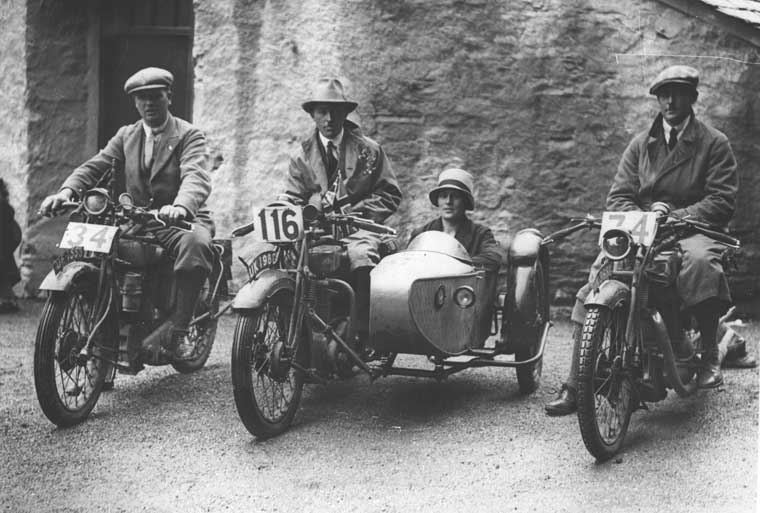
In those early years, each team had a sidecar included – and sometimes also a cyclecar. In these cases, the passenger was sometimes a woman.
Photo 2:
The team for the Silver Vase could be composed of three motorcycles (not manufactured in the team’ own country).
Photo 3:
During many years, the motorcycles taking part in the Six Days’ events were “normal” motorcycles, manufactured for a road use – not all roads were asphalted in the 20th century’s early years. Moreover, in the ISDT motorcycles were supposed to resist any off-road use. The biggest “enemy” was of course rain…
Photos: Coll. C. Lavery/FIM