
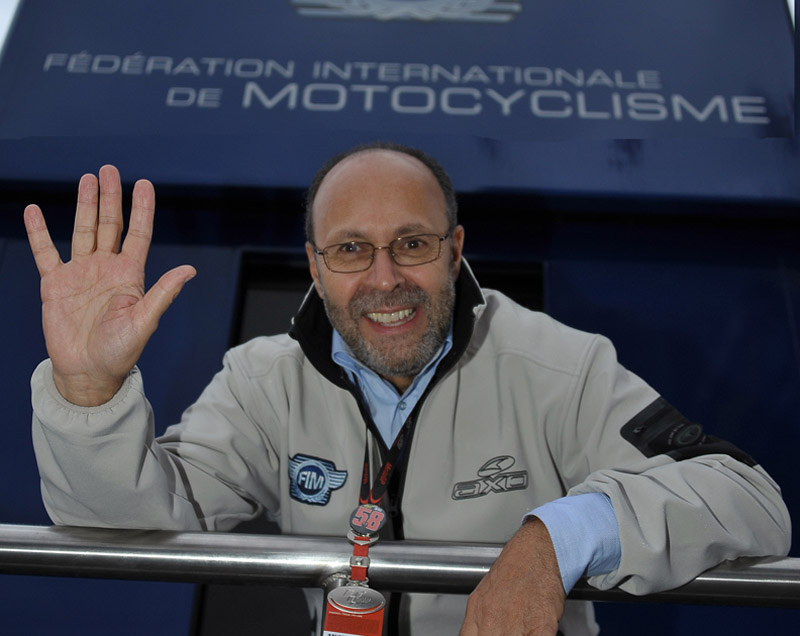
Guy Maitre, FIM Chief Executive Officer, arrived at the FIM in December 1978 for what should have been a short term mission. Now, five presidents and thirty three years later and on the eve of his retirement, he looks back upon the most memorable times in his passionate career!
Can you tell us some more about your FIM debut in 1978?
I arrived at the FIM by pure coincidence. The Secretary General at the time had resigned and President Don Nicolas Rodil del Valle was looking for somebody to revise the statutes. Since I had been working on international law during my studies, I was hired on a temporary basis as the President’s assistant. Within a short time, he entrusted me with the organisation of the Congress on the 75th anniversary of the FIM in Montreux, which was to be held the following year. It was an eye-opener for me who was more into athletics, football and rugby and although I had been riding a scooter during my studies, I had absolutely no clue about motorcycling. I have to say that that was a major handicap at the time. Today, it is not fundamental to have motorcycling knowledge when you begin in this domain.
When you arrived, how was the FIM structured?
In December 1978, the FIM had five secretaries – four women and one man, 45 affiliated national federations and a yearly budget of about 850`000 CHF. To give you an idea, in 2011 the number of FIM staff is 33, there are 103 affiliated national federations and for the first time our budget has passed the 21 million mark.
What are the major benchmarks in your FIM career?
I arrived at the end of one era and at the beginning of another. The President wished to restructure the administration in order to regroup all the commissions, some of which were scattered geographically. For instance, the Track Racing Commission was based in Berlin (Germany). But the major change then was the arrival of television in our sport and the awareness that television rights needed to be centralised. Each organiser was the holder of the television and commercial rights of his Grand Prix. Eurovision needed to negotiate with each organiser to broadcast the races, whether it was Grand Prix, Motocross, Speedway, etc… We realised that there should be a unique representative for TV and sponsors. We started a battle within the FIM family to take away from the national federations the management of their television and commercial rights. We had to make them understand that these rights had more value if they were centralised rather than scattered. It was the battle of the eighties. The first contract that we signed for Grand Prix with the Italian company OPIT was a disaster. The federations opposed it and it all ended up in a court case. At the end of the eighties, there was a second contract for an all new Championship – Superbike – for which the FIM had decided to manage these rights as of the beginning. So, the first big part of my career was to negotiate with the national federations who took a dim view of the FIM which was encroaching on their territory.
How did the FIM Administration transform at this time?
I would say that things then followed on kind of naturally. The sport developed considerably and grew enormously thanks to the global television broadcasting of the World Championships. Early in March 1981, I was nominated Secretary General and I immediately convinced the Board of Directors that it was necessary to provide this International Federation with a solid administration which was not the case at the time. When we moved the FIM headquarters to Mies in December 1994, the number of staff had gone up from five to thirteen. Commission secretaries had been hired; they were the forerunners of the present coordinators. There were not as many Championships at that time but we did not have any promoters and we had to deal with everything. The national federations organised their World Championship events themselves and each FIM Commission helped with the coordination of it all.
How did you experience the different changes in Presidency during your career?
All the FIM Presidents with whom I worked have played a very important role in the FIM. I started my career alongside President Rodil who “put me in place” to a certain extent. He taught me a lot and transmitted his experience to me. Retrospectively, I can say that he was my spiritual father, my mentor. Throughout my career I have had to deal with five Presidents, all with quite different personalities: Nicolas Rodil del Valle (Spain), Nicolas Schmidt (Luxemburg), Jos Vaessen (Netherlands), Francesco Zerbi (Italy) and Vito Ippolito (Venezuela). The advantage was that we knew each other already. I had known them in their various functions and they knew me as Secretary General. Each time, we managed to become relatively harmonious pairs. It is essential to make things move in the right direction. I think that the different Presidents have appreciated my professional qualities and gave me their confidence. We found a “modus vivendi” based upon mutual respect, avoiding encroaching on each other’s territory and I think it has worked quite well. All these Presidents were aware that they were there temporarily whereas the Administration symbolises continuity.
Nicolas Rodil del Valle was a great president; he was a visionary who realised the FIM’s potential in the long run. He was one of the first to understand the importance of television in the sport. He was also one of the first to say: “We have to go and see the Japanese manufacturers in Japan”, which for the time was rather revolutionary. I had the chance to be part of that first trip in April 1980. We went to China and then to Japan to meet the four motorcycle manufacturers. Rodil had realised that Asia would be the centre of motorcycling development. I was then a young man of 30 years and had the pleasure of meeting Mister Honda in person.
How would you define the role of the Chief Executive Officer compared to that of the President?
The FIM Chief Executive Officer is the one who makes sure that the FIM administration functions satisfactorily and runs smoothly. The administration is a body of services: we are at the service of our national federations who are our members and we are also there to serve the sport and non sportive motorcycling. Everything needs to function well: the training of our officials, the commissions, the finances, the logistics, everything that you cannot see. The CEO reports to the President and to the Board of Directors. He is in charge of operations but stays away from political questions. You could say that the FIM is doing well when the administration is not visible; we work behind the scenes; it is the sport that counts!
Who are the sports people that you admire the most?
Many riders have left their mark on me. The very first amongst them is Barry Sheene, who at the time represented riders in the Road Racing Commission; a very charismatic person. I remember seeing him get out of a white Rolls Royce at the Montreux Congress and I was really impressed. I found out afterwards that he had a deal with Rolls Royce and that wherever he went in the world, a white Rolls Royce would be waiting for him. A Russian multiple Ice Racing World Champion with the name of Anatoli Bondarenko also left his mark. He came from the Red Army. He was a specialist of the “outside line” of the ice racing ring. When he was not in front, he accelerated faster than the others: he was an amazing rider. I remember him being injured by the spikes of one of his rival’s wheels and yet he participated in the finals the next day with a leg that had just been stitched; a real “tough one”! There are many riders that fascinate me; like Valentino Rossi who really has put a mark on his time. Our sport needs charismatic persons. Riders who transmit humanity or values beyond their talent fascinate me. I have enormous respect for the Finnish Enduro rider Salminen and of course all the others. They have a lot of endurance. When the going gets tough, the tough get going; I am full of admiration.
What is your worst memory?
From the beginning, I have been confronted with difficult situations. On the occasion of the Montreux Congress, I was walking through the hallways of the Congress building when I saw a “World Series” sticker. That was my baptism of fire. That was when I understood that there was a riders movement against the FIM, against the big mistakes that the FIM had made at the time. The incapability of the FIM at one point in time to manage the security on the circuit, to be at the same level of what the riders were entitled to expect from it; they were risking their lives. This movement lasted for a long time. It took threats from the riders to boycott races; it took the foundation of IRTA (International Racing Team Association) for the FIM to change a certain number of things. This coincided with the arrival of the promoters in the early nineties. It raised the FIM’s awareness that it could no longer assure by itself the organisation of some of the World Championships and assume all the responsibilities that are incumbent upon an international federation. At the Budapest and New Zealand Congresses, we were forced to find solutions to share the responsibilities with a promoter for the Grand Prix; there was already a promoter for Superbike. Things then headed in the same direction in the mid nineties with a promoter for Motocross, etc. It is a bad memory for me because we had to force the mentalities to change and I think that is the most difficult thing to do. In any business or organisation, whenever you want to change a model that is no longer valid, there will always be crying and the gnashing of teeth.
After the worst, what are your best memories?
There are many! Perhaps the first one is the construction of the new FIM headquarters in 1994. At the time, the FIM was located in Chambésy in a villa in the Geneva suburbs. To construct and to have our own building was very important and I was lucky enough to take part in that beautiful adventure. Then, there was the moment that the FIM started to get involved with topics other than sport such as public affairs and road security. I have also been involved in the awareness process of the FIM that it had social responsibilities and had to take care of the environment. That is how the Public Affairs and Environment Commissions were born. The foundation of the Commission of Women in Motorcycling was next. This is a topic that I hold close to my heart. We could no longer ignore the other half of this world. It is time that our sport is no longer exclusively for men; not to mention that women represent an important market for the industry.
Another important chapter, with Vito Ippolito’s arrival in the presidency, was the creation in 2007 of a new visual identity and new logo for the FIM. This was a clear message to the world that the FIM is changing and the new logo is the symbol, the realisation of this evolution. This was then followed by the creation of a department with which the FIM would manage its own marketing and communications. Another positive moment was in June 2007 when the Board of Directors decided to initiate a strategic planning process. It was the first time in its 100 year existence that the FIM - together with its members and partners – decided to question its mission, its values, its objectives and its own future.
My last satisfaction is the finalisation of the strategic plan in Macau in October 2010 when the FIM adopted the new statutes and most of all put in place a new governance. The roles and functions of the individuals and organs are now clearly defined. There is a clear separation between the operational (the administration including the commissions) and the governing part (the Board and the General Assembly). One will not interfere with the other.
Now you have decided to take early retirement; why?
I think that 33 years, 30 of which as CEO is a lot. I have brought to the FIM a certain number of changes and I believe that today it is like a “rocket” with different levels. The first level gives an impulse and then the younger ones take over. I have done my bit…
How do you see tomorrow’s FIM; what would the FIM of your dreams look like?
I imagine a very similar but also a different FIM. I imagine it aware of the threats which befall it. They are numerous; we have already discussed some of them. An FIM that tackles the problems head on and offers proper solutions. We have to do more and better in the field of security, to reduce the sound level, to minimise the impact on the environment, to involve the women and to defend the interests of motorcyclists on the public roads. The FIM has a bright future ahead and lots of ambitious projects to carry out. We have a fantastic sport; there will always be a danger but not more than in any other sports. The FIM needs to continue to impose itself as a legitimate governing body in order to arbitrate all of these interests and stakeholders.
In your personal life, you must have projects that you would like to fulfil. Can you talk about them?
I have given a lot of my private life to bring to fruition my career and now I really would like to devote myself to my family and to personal projects. I would like to travel differently, take the time to visit countries. There are places that I have flown over such as Burma, India, and also certain Latin American countries. I would also like to do some volunteering work for causes that mean a lot to me. On the sporting side, I have recently discovered golf. This is a sport that requires time but that I can play with my wife.
Can I ask you to put in one sentence the message that you wish to leave for the FIM members for the future?
United we are strong, divided we are vulnerable. Keep the FIM family united!
BioMr Guy Maitre is Swiss; born on 31 March 1950, married, two children.
- Degree in Political Sciences, University of Geneva, Switzerland (1978).
- Languages: French, English, Portuguese, Italian, Spanish, German
- Started at the FIM in December 1978.
- Nominated as FIM Secretary General in 1981.
- Nominated as FIM Chief Executive Officer in 1998.
- Nominated Member of Honour of the Fédération Motocycliste Suisse (FMS) in 2004.
Photos captions from top to bottom FIM President Nicolas Rodil del Valle & Guy Maitre in 1979 FIM President Vito Ippolito & Guy Maitre in 2011 Guy Maitre & FIM Staff during the FIM Gala Ceremony 2011 by Isabelle Larivière