
1980: Confrontation at every level
* The central board met on 3 and 4 March in Geneva. First on the agenda was the approval of the minutes from the BC sessions (in general a formality), but Mr Dixon took the floor to state that the ACU was not satisfied with the membership of the Hong Kong federation accepted in Montreux. Hong Kong was a colony belonging to the British Empire and in this context according to the statutes, could not apply for membership. President Rodil replied that this matter should have been raised at the general council meeting in Montreux.
* Mr Rodil then explained the results of discussions between the representatives of the “World Series” – a project which saw the light of day after the riders’ strike in Spa Francorchamps – which had taken place in Chambésy in January. This attempt to stage a series of events in parallel to the world championship had failed. But according to some documents, some riders were planning to boycott GPs in the 1980 season, hence the warning to the FMNs to cut all ties with the promoters of the “World Series”. Don Rodil did not hide the fact that the responsible bodies from the FIM had made mistakes and were partially responsible for this state of affairs. Working methods must be improved quickly for things could not go on like this.
* Having said this, some board members thought that the statements made by some riders in the press were unacceptable. President Rodil agreed but thought that stormy announcements made by a member of the CCR over the last few months were even worse. This delegate had criticised the FIM and the central board in particular. Everyone was free to think and speak as he saw fit, but it would be preferable that an elected permanent delegate should work towards improving the federation. What was even worse was that this delegate had just released a photocopy of an official proposition featured on the agenda of the CCR. President Rodil thought it was unacceptable to make an internal FIM document available to the press.
* In the name of the FFM, Mr Lesueur commented on the endurance world championship. The introduction of the TT1 rules was premature and risked damaging the success of this formula – at any rate in France. But the CT was adamant stating that everyone had been informed since the Poznan congress (1978).
* Two new riders took part in the CCR sessions, the Dutchman Wil Hartog, a works 500 Suzuki rider, and the British side-car rider Jock Taylor. The subject of the Nürburgring, as was to be expected, and Imatra featured in the discussions. Wil Hartog expressed his views calmly. He was aware that some riders thought the two tracks were dangerous. “The problem with the Nürburgring is that the GP takes place there every two years and the riders do not know it very well, particularly the newcomers”. Taking into account the length of the circuit, Wil Hartog suggested that practice sessions should be much longer than anywhere else. As for Imatra, he did not think it was any more dangerous than other circuits. Jock Taylor agreed with Wil Hartog on the Nürburgring but said that practice sessions were expensive and he suggested that every rider should be able to make a lap of the track in a car free of charge. The German CCR member, Wilhelm Noll, a former side-car world champion, thought that the organiser could plan for three days of practice sessions.
* GP starting procedures were then discussed. Mr Cornet, the French delegate, acting in the name of French riders, suggested that the start should be given with engines running. Opinions differed and an enquiry had to be launched with other riders. There were risks of false starts, bottlenecks at the first corner and there was also the tradition involved in pushed starts. The CCR decided to launch an enquiry and for the moment retain the status quo.
* The introduction of a European road racing championship was agreed for 1981. There would be a minimum of three events and a maximum of ten for riders with FIM licences not featured on the GP priority lists.
* The CMT refused to delay the introduction of the new minimum weight for motocross. New rider representatives were Gerrit Wolsink for motocross (again, but he wasn’t there) and the Finnish trial rider Yrjo Vesterinen, triple world champion. It was confirmed that from 1981 onwards, the ISDT would have the status of regularity team world championship, but the term “Six Days” would be retained (tradition was stronger). For trial, Yrjo Vesterinen made a few remarks on various problems arising from the organisation of the championship, in particular, the drawing up of the calendar.
* An interesting point was that the FMNs were invited to forward their national regulations concerning “enduro” (sic, the first mention in an FIM report) to the CMT, with a view to drafting international regulations. The CMT asked the central board to contact the International Olympic Committee with a view to including trial in the 1984 Olympics. The CMT considered all criteria to have been fulfilled.
* At the CCP, Ivan Mauger and Ole Olsen were re-elected rider representatives, but both were absent. The 1981 speedway final would take place at Wembley and in 1982 it would leave Europe for the first time and go to the United States.
* The promotion committee re-emphasised some of its projects including the press service, motorcycle races for youngsters, advertising income, television, faster information on results. A meeting had been held with journalists in Montreux where it had transpired that the results from practice and the race should be available as soon as possible. The idea of an FIM magazine was muted but rejected for issues of language and staff required. A temporary solution was found with Mr Maitre by adding, if time allowed, a news page in the bulletin.
* Don Rodil informed the board of his intention to invite the AIT and the FIA to share a building which could thus become a “House of motor sport and tourism”. The first contacts with these two organisations which had taken place that very day with Prince Metternich during the signing of the FIM-FIA convention had been positive. Mr Soriano approved of the project and announced that the RFME was ready to advance a certain amount to bring it to reality. The central board was unanimous and authorised Don Rodil to take the necessary steps.
* Then president Rodil gave a detailed report of the visit made to Japan and China with the secretary general. The aim was of course to maintain close contacts with the four Japanese manufacturers, as well as the officials of the MFJ with a view to preparing the 1981 congress. He also emphasised the welcome from the Chinese authorities (Chinese motorcycling federation and national sports federation of China) and the enormous potential for the development of motorcycle sport in that country.
* Letters had been sent to the riders Kenny Roberts and Barry Sheene. Roberts’ manager had replied that his rider was in agreement to “make honourable amends”. No reply had been received from Sheene. At Zolder, neither Roberts nor the side-car rider Rolf Biland had appeared on the podium. But the board decided to suspend any measures on the matter for the moment.
* Don Rodil announced his intention to the board to stand again for his post in Malta, but that it would probably be his last mandate. It would be a good idea if the board were already to start thinking of a successor.
* The Malta congress (member of the Commonwealth) was held from 19-25 October under the responsibility of the ACU. The sessions took place at the “Grand Hotel Verdala”. Forty one countries were present or represented including forty with two votes and one, new member China, with one vote.
* Proceedings began with the big task of the proposals to modify the statutes and internal regulations. Don Rodil opened the debate by focusing on the foreword. The Czech federation had confirmed that the FIM had been founded in 1904 in Paçov (Patzau) in Bohemia. He explained that this information was wrong as proved by older documents from the archives which state that the FIM was founded in Paris in 1904 and dissolved in Paçov in 1906 by the founding members, before being reconvened in 1912 in London.
* Among the subjects under dispute was article 41 which defined the motocross and trial commission which many members wanted to see separated into two. The FMI proposed that one commission should take care of motocross and snow scooters and the other trial, enduro and the Six Days. Mr Bruneel, president of the CMT, was against this division arguing that the commission worked very well as it was. But others were of a different opinion and Don Rodil ruled that if there was a will to create a new structure, with the review of the statutes in progress, now was the time to do it. The council voted on separation: 24 federations were in favour, 16 were against and one abstained.
* The federations from Kuwait and South Korea were accepted as new members. Then, Don Rodil del Valle announced that he would be a candidate for the last time. And this time for the last one, he was re-elected with acclaim.
* Just as the session was closing, Don Rodil noticed that for the first time since he had become president, there were no ACU representatives on the central board. Unless he was mistaken it was the first time since the FIM had been founded. Times were changing…
* The Swiss Luigi Brenni was elected president of the CCR. The previous season was reviewed. It was the last time that the Nürburgring would be used for a GP. In endurance, neither the 24 Hours of Le Mans nor the Bol d’Or would count for the championship while the 1000 km of Brands Hatch were cancelled. For 1981, 14 GPs were on the calendar including Argentina (125, 250 and 350cc only). Since the track at Turagua was not finished, Venezuela was not on the calendar. The European championship had five events. Mr Brenni was organising a draft of standards for circuits. A meeting between the FIM and FISA had taken place in Geneva with a view to establishing common rules for such norms. At the joint CCR/CT meeting, safety belts (sic) for side–cars were banned. The 50cc class would be replaced by 80cc in 1984. The first endurance season using the TT regulations was considered satisfactory. Mr Goss emphasised that at the Bol d’Or (excluded from the championship because of the stipulated formula) the first and second places had been taken by TT1 machines. At the request of the CT, the CCR agreed that the Bol d’Or should be used as an experiment to test the possibilities of supercharged engines. 500cc turbo machines would line up against 1000 cc bikes with normal engines (the Bol d’Or was not part of the championship in 1981).
* In each class in the motocross world championship (125, 250, 500, side-cars) and for the trial world championship, the riders placed in the top ten places the previous year would receive a permanent racing number for the whole season which would be the same as the ranking (1-10).
* From 1981 onwards, all the regularity events would henceforth be called “enduro” races. The competition of the “world trophy” would be called the Enduro World Championship for national teams”. The CMT president, Mr Bruneel, confirmed the request he had made to the central board to ask the IOC to introduce a motorcycling event as an Olympic sport.
* Priority lists were drawn up for entries. From 1982 onwards, a rider would not be allowed to take part in a different world championship class than that which he had chosen at the beginning of the year. He could not take part in different classes in the same year even if it was a world championship event organised in his own country.
* IRRPA, the international road racing press association, had been founded and had sent its statutes with a request to be affiliated as an associate member. The president of the association was the Italian journalist Giancarlo Falletti.
1981: A dispute over TV rights
* The central board met at the Hôtel du Rhône in Geneva on 1 and 2 March with the following members present: Messrs Rodil del Valle (president), Matuszak (first vice president), Schmit (treasurer), Bosch, de Ambroggi, Haken, Lesueur, Soldati, Soriano Rodriguez and Youngblood (vice presidents), Brenni (CCR president), Bruneel (CMT), Petrczak (CCP), Puig Bulto (CT), Lechner (CCT), Pettinelli (CF), Estrada Guzman (CP), Rodenburg (CM) and Maitre who was appointed secretary general during the session.
* The modifications to the statutes were reviewed. For the new commission for trial and enduro, elections would be held in Tokyo. As for the CMT members who wanted to move to the other commission, they could do so freely and the length of their mandate would remain the same.
* Don Rodil explained the contacts that he had had with representatives from industry, especially Honda, where it transpired that closer relations were sought after by the manufacturers. A consensus emerged in favour of continuing dialogue and the idea of an industry consultative council at the FIM began to take shape (the future TACI).
* The IOC had issued an invitation to the FIM to attend the 11th Olympic congress planned for Baden-Baden (Germany) during September as an observer.
* The Argentinian GP was confirmed and work would be completed on the track at Imola before 15 March. Mr Brenni had to inspect the circuit (as well as Spa-Francorchamps) in the company of rider representatives (Wil Hartog and Jock Taylor). The CCR decided to drop the 350cc class from 1983 onwards and to replace the 50 class by 80cc from 1 January 1984.
* Drs Costa and Hadfield were appointed representatives of the medical committee at the CCR. Concerning the age of riders, the minimum remained 18 except for 50 and 125 road races, 125 motocross, trial and enduro. The ULM was planning to organise a South American motocross championship.
* An extraordinary session took place on 2, 3 and 4 July in Rome on the premises of the Italian National Olympic Committee upon the invitation of the president of the Federazione Motociclistica Italiana, Francesco Zerbi. The final text of the statutes and the internal regulations were adopted after a few amendments. The text was sent to the FMNs for approval by the general council at the Tokyo congress. The number of member federations was now 51.
* The central board decided to recommend the affiliation of IRRPA as an associate member at the Tokyo congress. The representatives from the journalists’ association, Giancarlo Falletti and Volker Rauch were satisfied and thanked the central board for exonerating them from the membership fees. They suggested that the association should pay a nominal fee. The affiliation of the BSPA was also accepted.
* The members of the FIM/Industry working group were in favour of creating a consultative council for holders of manufacturers’ licences A and B with two representatives sitting without voting rights on the technical commission and the general assembly. Don Rodil was of the opinion that there was an imbalance within the FIM in favour of European industry representatives and that it needed to be rectified. The make-up of the consultative council would be determined in Tokyo.
* Talk then moved to television and the atmosphere soon degenerated as often happens when it comes to money. The issue on the table was the rights with which the national federations and organisers did as they pleased or almost and which president Rodil thought should remain under the control of the FIM who was the true holder. In his opinion national federations were only delegated these rights. A draft framework contract with the European Union of radiodistribution (UER) had been drawn up and would be discussed in Tokyo. The UER would like to negotiate henceforth with the FIM rather than each National Federation and organiser individually. Some FMNs were visibly anxious to see the FIM enter into negotiations with television companies since they had already signed contracts themselves and they wanted to have just as good – if not better - financial conditions for the world championship events they were mandated to organise.
* As one can imagine, president Rodil was furious. He argued vigorously against this approach. According to him the FMNs already received money on the back of the FIM thanks to the world championship titles which belonged to the international federation who owned the broadcasting rights. Mr Youngblood was not against negotiating a contract with the channel ABC, but recommended caution because it was “particularly difficult to negotiate with television companies and conditions had to be carefully examined”. Mr Haken believed that the FIM should obtain the prior agreement from the FMNs involved in a television contract, which incensed Don Rodil still further. “Broadcast rights for events with the title of world championship belong completely to the FIM”, he thundered. Then things calmed down a little. The president announced that the contract would not be signed before the conditions had been presented to the central board.
* The Tokyo congress was held from 5 to 12 November in the rooms of the hotel Keio Plaza. This was only the second time after Caracas in 1977 that the FIM had held its meetings outside Europe. Thirty seven countries were present or represented including three by proxy at the first session and 38 at the second session including two with just one vote: China and Hong Kong (!).
* The statutes were ratified after several discussions and exchange of views. Upon the proposal of the MCM, the CCT became the “Commission for tourism and gatherings” (CTC).
* One curious measure was the KNMV’s proposal to hold a meeting of FMN secretaries general at the beginning of every year under the presidency of the FIM secretary general. The general council refused this proposal (as an article in the statutes).
* Requests for membership were accepted for the national federations of Costa Rica and Nigeria.
* Following a series of fatal accidents in the Netherlands during the 1980 season, the government had decided only to authorise racing on closed circuits with TV cameras covering the whole of the track. The extension of this rule to all the tracks was the subject of much debate. It was easier to propose rather than to implement.
* Then Don Rodil reported on the negotiations in progress concerning television rights. Some delegates wanted the FMNs to retain their sovereignty in the issue but president Rodil categorically refused. The FIM is nothing more than the grouping together of all these federations and according to the statutes, the titles of the world championships belonged to it alone. Yrjo Vesterinen, triple trial world champion, requested that riders should not be obliged to wear bibs with advertising that was not in the interests of the riders or their sponsors.
* At the CCR, since Wil Hartog had stopped racing, he was replaced by Angel Nieto as rider representative. He immediately drew attention to himself by interrupting the general council in full session and criticising the inclusion of Imatra and Brno in the calendar. At Imatra the track included a level crossing and the trees were at the edge of the track. In Brno, the track ran through the middle of a village. This interjection provoked others which led to a secret ballot which confirmed the CCR decision – Imatra and the old circuit at Brno would be used for the last time in 1982.
* The technical commission discussed the introduction of supercharged machines which at the time looked like they were going to invade the market. Endurance and Formula TT were concerned. The question of the cylinders in aspirated and supercharged engines had to be discussed with the constructors.
1982: New statutes, new names
* The spring meetings held from 18 to 21 March 1982 in the rooms of the Hotel du Rhone in Geneva, marked the entry into force of the new statutes. The general council became the “General Assembly”, the central board the “Management Council”. The finance board became the “Auditing and Financial Management Committee” and the “Judicial Committee” the future “Judicial Panel”, was convoked for the first time.
* There was more talk of television. The contract with ABC Sports was signed for the next five track racing finals (speedway, 1983 and 1984, ice 1982, 1983 and 1984) for the amount of US$ 350,000 to be split between the organising federations and the FIM. A company specialised in public relations and advertising based in Milan, OPIT, had made some proposals on a project to promote and distribute images from motorcycle races. According to president Rodil, talks ought to be held with this company by the television working group.
* Then president Rodil reported on the discussions he had had with the IOC president, Mr Samaranch. The recognition of the FIM by the IOC would be supported by Mr Samaranch at the programme committee level before which it had been presented (the provisional recognition of the FIM would finally only take place in 1998). On the other hand, Don Rodil’s dream – the house of sport – was crumbling. The AIT and the FIA had already declined and Mr Samaranch pointed out that he had a definitive commitment with the city of Lausanne, so there would be no location grouping together several sporting federations in Geneva. The villa at Chambésy could still welcome several extra employees…
* Then attention turned to the Association of promoters and organisers of road racing events (ROPA) which had recently been formed and whose president was none other than the former CCR president, Mr Jaap Timmer. Don Rodil believed that this association was working against the interests of the FIM and the FMNs but other council members did not go so far. ROPA was in fact preparing to request an associate membership of the FIM. Mr Bosch, who had attended a meeting of this association, said he had never had the impression that ROPA was devising a plot against the FIM. It would therefore be reasonable to strike up a dialogue with it before taking a decision. But Don Rodil warned the management council against adopting an over conciliatory attitude to the detriment of the authority of the CCR and the FMNs.
* At the CCR, the elected riders were Jock Taylor and Franco Uncini. Requests for a GP were presented: South Africa, Finland and Czechoslovakia, on condition of being homologated, and in the case of South Africa, of the organiser accepting the financial conditions. The circuit at Montjuich was strongly criticised by the riders and endurance teams. A new inspection would have to take place for the 1983 event, but the 1982 race was retained – it would be the last, an accident during night practice would sound the death knell for the famous urban track. For Brno and Imatra, it would also be the last year the riders passed through the houses in the Czech village and between the trees and telegraph poles of the Finnish track, unfortunately in tragic circumstances.
* The riders’ representatives at the CMS were Gerrit Wolsink (once again) and Jaak Van Velthoven. Discussions focused on a proposal to increase the number of riders obtaining championship points from 10 to 15, starting in 1983. At the CTE, Yrjo Vesterinen was once again elected to represent trial riders and the Italian Augusto Taiocchi for enduro. The appendices for the trial des Nations and the European trial side-car championships were elaborated. The 1983 calendar was drawn up with 12 trial events, six enduro Two Days, plus the Six Days in Great Britain – in 1982 they would take place in Povaska Bystrica in Czechoslovakia. At the CCP, the Dane Ole Olsen was once again elected to represent the riders together with Henry Kroeze. The minutes indicate that “communication with the president had become very difficult since last December. So the CCP turned to the vice presidents (in particular, Mr Novak, as acting vice president for a long time) concerning matters which had arisen since the Tokyo congress. Mr Pietrczak was not at the Opatija assembly, in fact he had already been sidelined, officially “withdrawn by his federation”. (The real reason was his avowed allegiance to the “Solidarity” movement). The delicate political situation in Poland also meant that some events were cancelled.
* The technical commission accepted the final report with the new limitations on engine capacity in endurance and in Formula TT (maximum 750), starting in 1984. Finally the medical committee discussed the limitation of riding time in endurance: a maximum stint of three hours followed by a rest of minimum two hours. If the length in the saddle was less than three hours, the period of rest should be two thirds of the time spent riding. Dr Costa said he thought it was essential for there to be three riders in a 24 hour endurance race, which was a view not shared by the other members of the committee, who believed that the number of riders had nothing to do with the medical committee. The presence of a doctor during road races and motocross events was accepted in principle by the management council, but this proposal had its financial ramifications. A procedure was agreed concerning the taking of samples during drugs testing. It conformed to the general conditions laid down by the International Amateur Athletics Association (IAAF).
* The autumn congress was organised by the Yugoslav federation (AMSJ) from 20 to 25 October at Opatija on the Adriatic Coast. A tribute was paid to the side-car rider, Jock Taylor, who had been killed during the last Finnish GP in Imatra.
* 44 federations were present or represented (including 6 by proxy), during the first session of the general assembly.
* The next point was to agree the minutes of the commissions and committees which in general was purely a formality. But sometimes things happened differently. Mr Werner Haupt, member of the finance board and OMK president, explained that the article foreseeing two weekends blocked for the Tourist Trophy was unfeasible and proposed just one weekend. A discussion ensued and Don Rodil proposed that the CCR itself should settle this matter, since it had decided to block two weekends in 1978. The CCR decided in its session to drop this privilege, which enraged the ACU representatives. But the general assembly vote was conclusive: 27 votes for abolition, 8 against and 4 abstentions.
* Following the AGFIS general assembly in Monaco, president Rodil announced that he had made the request for the inclusion of the sport of motorcycling in the “World Games II” to be held in London in 1985. The president explained that he had defended a more democratic system of electing officials to this organisation and had announced that he was against the more and more systematic distinction between Olympic and Non-Olympic sports.
* The inclusion of the GP of South Africa in the 1983 calendar provoked a wave of protests, mainly from representatives of eastern countries, arguing that the FIM “was embarking on a policy of encouraging racism in sport” and that the IOC condemned the policies in force in South Africa… at a time when the FIM was requesting recognition from the Olympic movement. Don Rodil replied that recognition had not yet been obtained and that as a consequence, the FIM did not know what the conditions and obligations would be. In short in a vote between the two sides, a secret ballot was requested by Mr Haupt. The general assembly approved the South African GP by 57 votes to 24.
* At the CCR, the privilege of blocking two weekends for the TT was dropped by 9 votes to 6. Then the various events were reviewed. A report drawn up on the GPs of Yugoslavia, Great Britain, Sweden, San Marino and Germany was distributed during the session so that the commission could take note of it. This report had been written by Mike Trimby, the official delegate for the Hong Kong Automobile Association (HKAA) on the basis of information given by the reigning 500 world champion, Franco Uncini – now the riders’ delegate in the race direction. Mike Trimby had been chosen by Franco Uncini and other riders to be their secretary, with the aim of “informing the CCR in writing of the different problems relating to the GPs”. (He has since then become the general secretary of IRTA, the GP teams’ association).
* Following economic restrictions imposed by the state, the Federacion Argentina (FAM) could not organise a GP in 1983. The circuits of Brno and Imatra were dropped from the calendar as well as Montjuich. The Spanish GP would take place in Jarama. The Czechoslovakian GP returned in 1987 on the new track, but the Finnish GP disappeared permanently. Jock Taylor’s accident – another side-car crashed at the same place on the following lap, in spite of the yellow flags – was the straw that broke the camel’s back. Finally Mr Luigi Brenni was re-elected president of the commission with 12 votes out of 15.
* At the CMS, a new president was elected by acclaim, Mr Tage Magnusson,
* At the CTE, the number of requests received to create a trial des Nations was so great that the commission requested the management council to include this event in the calendar from 1984 onwards. Next on the agenda was the Six Days. Some problems had been experienced in the event in Czechoslovakia by Spindleruv Min. The police had been everywhere and the excessive zeal of the marshals appointed by the organisers was by a long way not to everyone’s taste. The commission “hoped that future events held in Czechoslovakia would be free from any police interference” (sic). Mr Eric Schmidt was re-elected vice president of the CTE alongside Brian Bonny.
* The Swedish rider Eric Stenlund received marks of distinction from the CCP for his fair play during the 1982 world ice racing final at Inzell on 13 March. He had left the track with his bike to avoid hitting another rider who had fallen in front of him and had fractured his collarbone.
* In speedway, the commission was in favour of using normal tyres of a road-going variety for international competitions starting in 1984. The tyres currently being used offered too much grip and were too expensive. Ole Olsen explained that he had tested normal tyres this season and had ascertained that riders were slower at the start which was in itself a factor for improving safety. The German and British federations were requested to conduct tests on long track and grass track and to present a report.
1983: The last for Don Rodil
* Don Rodil del Valle opened the session of the management council on 28 February 1983 at the Hotel du Rhone by paying tribute to the first vice president Bogdan Matuszak who had passed away on 10 February following a long illness, as well as Andrea Ippolito, CCR member and president of the Venezuelan federation and the ULM who had died suddenly in Caracas on 13 February.
* Considering his withdrawal from the FIM presidency at the next congress, Don Rodil proposed that the mandate of interim Deputy president should not go further so that the new president could propose the Deputy president of his choice in complete freedom.
* A large part of the session was devoted to examining the proposals for changes to the sporting code and the new numbering of the appendices. The points system was also discussed: the CMS and CTE were in favour of giving points to the first 15 (20, 17, 15, 13, etc) instead of ten (15, 12, 10, etc). Don Rodil would have preferred that the commissions agree among themselves to adopt the same system for every discipline.
* Then articles 82 and 83 of the statutes were interpreted in view of the elections to be held in October. In fact, the only candidate on the horizon was the treasurer Nicolas Schmit, with no other agreement having been reached concerning another candidate.
* At the CCR, in endurance, for races lasting more than 12 hours, the team had to include three riders. Press facilities were reviewed: a minimum of 50 seats with tables and chairs and possibly typewriters, televisions (if the race was being broadcast), bar, lockers, telephone room with 10 phones including 3 in a closed booth (radio, TV...), possibility of collect calls, telex room with four machines, six message punchers (a minimum of four permanently), the possibility to pay by credit card or cash, separate work rooms, open until 10h00 and up to four hours after the race.
* The duties of the rider representative were once again reviewed (opinions differed). It could be a current GP rider or a rider having taken part in GPs in the previous five years or someone enjoying the riders’ trust. For the moment, Mike Trimby was officially Franco Uncini’s secretary during these sessions.
* The CMS briefly returned to the circumstances which had led to the Luxembourg 500 GP being removed from the calendar in 1983. Safety could not be guaranteed and supporters had even attacked some riders! The system of rotation between countries to organise GPs was abandoned. The CMS also requested the Soviet federation to facilitate the border formalities for riders by issuing a special visa, for if this problem could not be solved, the future of the GPs in question would be in doubt. The riders’ representative, Jack Van Velthoven, requested that the national federations should give more freedom to their riders so that they could take part in more international races, which was in the interests of the sport. The commission believed that the whole issue of world championships for national teams should be reviewed and a revision of the regulations was necessary. The proposal of awarding points to the first 15 in each heat was accepted from 1 January 1984 onwards.
* The CTE announced that the first trial des Nations would be held in Poland at Zakopane on 16 September 1984.
* The CCP board had learned with regret that the Wembley stadium could no longer accommodate speedway events – football was taking more and more precedence and the speedway track had been removed for there was apparently no team from the British League racing there.
* There was much talk about tyres at the technical commission. For speedway with a groove at least 8mm deep, a homologation was agreed for enduro, and for trial and motoball machines.
* The CTC reviewed the various rallies and outings. The possibility of organising motorcycle tourist events in the USSR was raised since access had been impossible since the 1967 rally. An intervention by the FIM president was muted. Finally the judicial committee once again reviewed articles 82 and 83 of the statutes which covered candidates for the presidency. Such candidates must: be a member of the management council for at least three years prior to their nomination, understand and communicate in one of the official FIM languages and be proposed by their own national federation. If the current mandate came to an end, standing again was automatic, but in other cases, the nomination should be accompanied by the resignation with immediate effect from the duties currently held. For every candidate two rounds of votes would be held with the majority half plus one of all the legal votes present at the general assembly. The judicial committee also believed that an honorary member could not hold an executive position within the FIM and that he could not simply renounce the honorary position to do so. He could receive a representative mandate or a temporary delegate mandate.
* The 1983 congress which marked the withdrawal of Don Rodil del Valle from the presidency, took place in Benalmadena near Malaga (Spain) from 22 to 29 October. No less than 45 national federations were represented by their delegates or by proxy. In 1983, the total number of member federations was 52 plus four associate members, all present in Benalmadena.
* The general assembly began with a minute’s silence for Messrs Matuszak, Ippolito and also Norman Dixon (honorary FIM vice president and ex-chairman of the ACU). The president emphasised the role Andrea Ippolito had played in the development of motorcycling in Latin America with the formation of the Latin American union of which he was the co-founder with the Brazilian Eloy Gogliano, his role in the emergence of champions such as Johnny Cecotto and Carlos Lavado, as well as the organisation of the first overseas congress in Caracas in 1977.
* Concerning requests for membership, New Zealand had submitted a complete file as well as the agreement of the ACU – necessary because it was a member of the Commonwealth. This was not the case for India whose request for membership is mentioned… but to the ACU and not the FIM for which Don Rodil requested clarification.
* They then turned to the major point: the change of president. After discussions about procedures, Mr Nicolas Schmit was finally elected president of the FIM with 58 votes. Mr Brian Bonny was elected treasurer. Mr Haupt became the president of the CCF.
* Then the organisation of future congresses was discussed. The Guatemala federation confirmed the invitation it had issued in 1982 to organise the 1985 congress. Italy was a candidate for 1986 and Portugal for the next year since in 1984 it would be held in Munich.
* Things were moving slowly at the CCR so as not to hurt anyone’s feelings. The report drawn up in the name of the riders’ representative Franco Uncini, by Mike Trimby was “privately valid; it was distributed only to those interested by the event in question”. Franco Uncini confirmed that he had approved the contents of this report and that during his absence following his accident in Assen – after falling he had been hit by Wayne Gardner – the 500 class riders had also approved the report.
* At the CMS the main subject was the change in formula for events for national teams, in other words, the cup, the trophy and the motocross of Nations which brought together the three classes in one single event with three races lasting 30 minutes plus two laps and each class running against the other (125/250, 125/500, 250/500).
* The principle of circuit homologations being valid for three years and the elaboration of a permanent file for each circuit were confirmed. In 1983 England had tested the idea of programming national races over three heats of 30 minutes each which had increased the number of spectators. The French federation was planning to adopt a similar system and it was scheduled to address this issue again the following spring. The CMS noted the boom in “superbiker” events (precursor to the supermotard) and proposed to elaborate regulations for these events known as off-road. The establishment of an indoor motocross trophy which would be called the “Rodil Trophy” was under review, explained Mr Magnusson, president of the commission.
* At the CTE, the new scale of points was accepted (20, 17, 15, 13, 11, etc) for the top fifteen and would come into force in 1984. For the Six Days, it was suggested that any report containing infringements to the rules should first be presented to the jury without mentioning names or numbers of the riders with the identification of the riders being made only after the jury had reached its decision. Time sheets should not be shown to the members of the jury, for they would then be immediately implicated in the matter. Only the team bosses should have access to the time sheets.
* At the CCT, discussion turned to the organisation of the first FIM 1984 winter gathering, which was to be in Viareggio (Italy) at the beginning of March 1984. The 1984 FIM rally was to be held in Assen in September. The number of organisers of tourist events was constantly on the increase. Studies on the fair play trophy were continuing.
* The medical committee informed that a mobile clinic was being created, proposed by the FMI at the instigation of Dr Costa. The CM suggested to the FMI to send a letter to all the FMNs asking if they required the clinic to be present at their events. A project for a medical code was under evaluation. Dr Hadfield was elected president of the CM – and Dr Costa vice president – following the withdrawal of Dr Rodenburg, who had been elected FIM vice president.
1984: First mandate, first difficulties
* The spring meetings took place in Geneva at the Hotel du Rhone as usual but for the first time since their introduction in 1967, with a new president. The management council was composed of the following members: Nicolas Schmit, president; Neville Goss, first vice president (appointed on 24 February); Brian Bonny, treasurer; vice presidents Lech Baran, Kurt Bosch, Jan Krivka, Jean Lesueur, Nicolas Rodenburg, Luis Soriano Rodriguez, Ed Youngblood and Francesco Zerbi and the commission and committee presidents Luigi Brenni (CCR), Tage Magnusson (CMS), Klaus-Peter Schroeder (CTE), Franci Novak (CCP), Oriol Puig Bulto (CT), Roger Lechner (CTC), Werner Haupt (CCF), S. Escriva de Romani (CP) and Gordon Hadfield (CM). The secretary general was still Guy Maitre and the outgoing president Nicolas Rodil del Valle presided over the session until the books and accounts for 1983 were approved and he was discharged for them together with the interim treasurer Neville Goss. The transfer of powers could then take place. President Rodil thanked the council for its collaboration throughout his mandate as well as the secretary general and the FIM staff.
* President Schmit thanked the outgoing president and briefly retraced the 18 years of the Spaniard’s tenure mentioning the difficulties he had had to face in particular the introduction of an efficient secretariat which had finally been achieved. He then broached the subjects to be considered such as the sporting code, the improvement of the sporting regulations, relations with industry and FIM assistance to FMNs who organised few or no international events. He addressed the commission presidents with his preoccupations of safety issues and the necessity to reduce the power and speed of the machines.
* But the problem immediately confronting the council was infinitely more substantial and serious. At the request of the new president, the honorary president summarised the situation concerning OPIT, the company supposed to improve the FIM’s image, to increase awareness and especially to take care of TV rights. During a catastrophic meeting with representatives from federations organising a road racing GP in 1984, the OPIT representative had presented no concrete plan for the televised broadcasting of these GPs and had not convinced any of the delegates present. On the contrary, he had rather reinforced their distrust of OPIT. The honorary president therefore demanded modifications to the contract – which was for review on 31 December 1983, with the inclusion of the commission presidents in the surveillance group and a different formulation for the clauses covering damages and interest to be paid if the contract was broken prematurely.
* These demands were sent on 15 December, but OPIT only responded at the beginning of February which had led Don Rodil to believe that the contract was suspended, but OPIT replied that no suspension was foreseen in the contract. A meeting with the OPIT representative was scheduled for the next day. But President Schmit was pessimistic and believed already that OPIT had not fulfilled the hopes which the FIM had placed in it. The problem was how to withdraw from the contract without incurring damages. A discussion in the council produced a majority in favour of denouncing the contract. So a Swiss lawyer had to be hired.
* The European racing championship was taking shape and there were already eleven organisation requests for 1985, although a request to reduce the registration fees for the continental championship was on the agenda, which was a paradox to say the least and surprised the council. Mr Bonny suggested a global re-examination of the tariffs, but the problem did not stop there: the Venezuelan federation was refusing to register the Latin American championships in the calendar because it considered the tariffs too high. This way of reacting brought the recognition of the FIM into question and required solutions which were both financial and political to help less developed federations.
* Mr Brenni announced that the European mountain championship had virtually ceased to exist with the OMK cancelling the German round leaving just two events (a minimum of three was required). Don Rodil recalled that this championship had been instituted by the FIM 50 years ago on the principle of rounds, even before the road racing championship proper.
* Next on the agenda was the World Games in London. The honorary president and the treasurer, i.e. Messrs Rodil and Schmit, had taken the decision to enter motocross and speedway during the AGFIS meeting of 1981. It was for the ACU to organise this participation but financial considerations were also involved since the promotion company for the world games had spent a lot of money on the first edition of this event which it was hoping to recoup on the second edition.
* When it had been created, the presidency of the judicial committee had been conferred on the Deputy president with the intention of clearly marking the independence of this committee with regard to the management council in its capacity as a consultative body to the latter. Since then the situation had evolved and the independence of the judges, now achieved by their active role (and fortunately not purely consultative) was now under discussion. The secretary general compared the current situation to that of a prime minister who was also the president of the supreme court. For the moment the TIA members elected their president for each case.
* Another subject which is remarkably similar to the current situation was the prize giving ceremony upon invitations issued to the world champions for the FIM congress gala dinner. The problem arose with the world championship teams (motocross, speedway, etc). The invitation was issued by a circular letter and only mentioned the individual world champions (solo and side-cars). The policy had been adopted of not inviting the teams due to financial reasons. As Mr Ed Youngblood remarked, if the AMA had sent its world champion motocross teams, this would have created a sizeable expense for the FIM. But the real problem was the ceremony itself, which was not satisfactory. Mr Baran proposed that the medal and diploma should be presented during the last final or last GP so that the public could be present. The promotion committee was entrusted with examining the issue.
* A serious problem was looming on the horizon. The situation in Guatemala which had submitted its bid to host the 1985 congress was by no means stable. There was even talk of open civil war and serious violations of human rights. In addition travel would be very expensive and certain federations would not be able to foot the bill. A decision would be taken during the session in June.
* The new formula for the motocross des Nations with the three classes in one single event would come into force on 1 January 1985. Concerning snowmobile races in the United States, the AMA delegate, Mr Moulton, gave some explanations. The “International Snowmobile Racing Inc.” (ISR) had been founded in the USA in 1980. Every year, a series of races named the “World Series of Drag Racing” had been organised with cross races on snow, snowmobiles and races on oval tracks. These activities were not very popular in the United States except in states where the climatic conditions permitted such events to be held. A collaboration between the FIM and the ISR was perhaps possible on condition that the CMS could manage to draw up regulations flexible enough for international races.
* The CTE accepted the proposal to make the “Silver Vase” more attractive by imposing an age limit of 23 and raising the profile of the event to the rank of world junior trophy on 1 January 1985. The commission also proposed to rank long distance enduro races and rallies in the category of “motorised marathons”. It also accepted to change the status of the European Two day enduro championship into a world championship event.
* Concerning the 1985 world games in England, the SCB/ACU was, reluctantly, according to the minutes, organising a speedway race. The CCP insisted on the fact that the sporting commissions and the FMNs involved should be consulted before the FIM committed to such projects.
* At the technical commission talk turned again to supercharged engines: for two strokes and four strokes or only for four strokes? Only four strokes! Ratio 2:1 or 1.5:1? Another vote was taken and resulted in remaining at 2:1. Then taking into account that the formula TTF 1/endurance had been reduced to 750cc and that the 500 two strokes were not always prototypes, some were thinking of requesting the capacity to be reduced to 400cc… in order to “redress the balance”. The proposal was not accepted, but the matter would be raised again in a short while.
* An extraordinary session of the management council took place on 23 and 24 June, still at the hotel du Rhone. This time Don Rodil was not there and neither was Luiz Soriano nor De Lech Baran who had died suddenly of a heart attack in his 50th year.
* Concerning the commission proposals, the council believed that elevating the European Two Day enduro championship to the status of world championship was premature. It would be better to simplify the regulations (sic). The world junior trophy replacing the “silver vase” was accepted. The management council thought it unacceptable (sic) that the CCP should question the decision of taking part in the world games. The CDD also pointed out that it was not within the jurisdiction of the commissions to set the tariffs which had too much been the case in recent times.
* President Schmit announced that after thorough discussions with the FIM lawyer, the decision had been taken to break the FIM/OPIT contract. The matter was now in the hands of lawyers for arbitration. ABC sports had confirmed that it was not in a position to renew the contract for speedway and ice racing.
* Mr Goss reported on the negotiations in progress with the organisers of the world games 1985. For motocross, an international race would be organised at Farleigh Castle, the day after the British 500 GP. For speedway, a pairs event would take place in Wimbledon. The problem for the organisers was to acquire sponsors since some had withdrawn; other negotiations were taking place. Rebroadcast by satellite and cable was planned and negotiations were also taking place with the UER. So there was still a certain amount of uncertainty.
* The 1985 congress would not take place in Guatemala in view of the current crisis. The organisation was entrusted to the Portuguese federation who had applied. Then president Schmit proposed a total review of the statutes and the internal regulations with the project submitted to the general assembly. The FIVA had contacted the FIM with a view to signing an agreement defining the respective competence and authority of the two federations. The FIVA did not take care of racing only demonstrations and vintage rallies and was willing to recognise the FIM’s authority in vintage races, but in return wanted the FIM to recognise its own authority in terms of non sporting events.
* Mr Magnusson submitted a detailed report on supercross (at the time, the FIM called this sport “indoor motocross” and “stadium motocross”). The situation was developing very quickly and several organisers in Europe wanted to establish a supercross series. But one step at a time had to be taken. Mr Magnusson suggested that a working group should be established, that an FIM series (sic) should be created which would begin after the motocross world championship in 1985, that a meeting be held with the organisers and the NMFs chosen by the CMS to organise these events and to finally launch the Rodil trophy in 1985 whether it be a single event or a series.
* The 80th anniversary of the FIM would be celebrated in modest fashion according to the wishes of the council, with stickers, special logos and medals, etc.
* The1984 congress took place in Munich with sessions being held at the Hotel Hilton from 21 to 27 October. 46 federations were represented (including 8 by proxy), which was a new record. Don Rodil was present as well as Gérard Ladame. The general assembly observed a minute’s silence in tribute to Messrs Pieter Nortier, honorary FIM president, and Lech Baran, FIM vice president and former member of the medical committee who had both passed away during the year.
* The request for membership from the “Singapore Motor Sports Club” was accepted as well as the international Vespa clubs federation as an associate member. The decision concerning the ARMCO (Association of Racing Motorcycle Constructors) was deferred until the spring meetings for additional studies – in fact the ARMCO was an association of competitors or teams.
* Among the discussions, one point was looming on the horizon. The Soviet Union federation had collated a voluminous document aimed at excluding the South African federation. The reasons were obviously political and the FIM whose statutes mentioned national federations and not countries or nationalities, did not become involved at this point. But the problem would come back in force the following year.
* The secretary general indicated that he had received a request for co-operation from the international BMX federation (bicross) which was cross on bicycles practised by youngsters who then turned to motocross. At that time, BMX appeared to be an ideal training ground for motocross.
* The executive council of the World Games had requested the FIM to withdraw motocross from the 1985 world games because the budget for the event was too high and the finances were not excellent (sic). The ACU suggested replacing the motocross with indoor trial at Crystal Palace in order to maintain two motorcycling events, which was greeted with enthusiasm by the organisers.
* Mr Goss gave a report of his presence at the FIA road sub-committee meeting. He had to go to Brussels with a representative from the international board of motorcycle manufacturers in order to give an opinion on the EEC regulations limiting the speed of 125cc bikes to 50 km/h… which was perfectly absurd. Mr Goss believed – and rightly so – that it was an occasion for the FIM to participate at government level as a body representing motorcycling. The management council therefore charged him with continuing this task in 1985.
* At the CCR, Martin Wimmer was the rider representative, since Franco Uncini was absent. The new track at the Nürburgring was homologated from 1984 and the one in Suzuka, Japan, from 1985. The 8 Hours had formed part of the endurance world championship since 1980 but the Japanese GP would only be organized as from 1987. For 24 hour races counting for the championship, the points score would be doubled (30, 24, 20, etc). With the aim at increasing interest in the TT championship, a CCR/CT working group was charged with studying a new formula with machines very close to production models. The CCR also gave its agreement to the AMA to organise a series of events in 1985 – “International Superbike Master Series” – with machines conforming to the AMA technical regulations. The events had to be registered in the FIM calendar and riders had to have international licences.
* A survey had been conducted among riders during the 1984 Assen GP. Of the 200 questioned, 60 had responded, nearly all riders were against private testing but in favour of free practice (one day rather than two) and in favour of a standing start (37 against 23).
* Concerning the Rodil trophy for stadium motocross, the management council gave its agreement for the first edition to take place in 1985. The CMS president had elaborated a regulation for this new discipline which was submitted to the commission and would come into force exceptionally on 1 January 1985, so a year would not be lost. The Rodil trophy would continue for a few years before disappearing. During this time, supercross in the United States and Europe gained enormous success, mostly due to its heightened spectacle. The impressive jumps by the riders attracted massive crowds.
* The creation of a European individual 125 and 250 motocross championship, run over five events and reserved for riders under 21 was being considered. In spite of Mr Glaus’ positive report on the subject of the French motocross championship run over three heats, and the fact that other countries were interested in adopting this idea, the CMS decided not to change the formula for the moment.
* In track racing, the committee noticed that the spectacular side of the sport was rapidly degenerating. This was deemed due according to the report to the poor quality of the track surface. The CCP severely criticised all the organisers who were not respecting the standards for circuits. Mr Novak suggested that the tracks designated for a world final should be inspected the previous year.
* Authorisation was given to the KNMV to test the idea of a two day world speedway final over two days in 1987. The discussion was long. Mr Collins, representing the riders, drew attention to the fact that his peers preferred to keep the current formula. Climatic conditions were very important in speedway, much more than in ice racing (which used the formula of two days). The motoball cup would become a European championship from 1986 onwards.
* At the technical commission, Mr Puig Bulto gave a report on the session with industry. Honda’s proposal to limit engines in the 125 category to one single cylinder was generally accepted. It was necessary to find agreement on a date for it to enter into force which would be discussed during the spring meetings 1985.
* The CTC was commemorating its 50th anniversary (it had been created in 1934 as an international motorcycle touring committee).
* The promotion committee proposed to introduce, in collaboration with the CTC, a tourist card for users with certain advantages such as discounts, facilities, etc as well as the development of a catalogue listing the arguments in favour of motorcycle racing. The prize-giving ceremony would remain at the congress, rather than at the headquarters of the FIM in Geneva end November or early December as Mr Brenni had suggested. The CP also proposed that a yearly book should be produced, the “FIM Golden Book” which would outline the principle events which had taken place in the world championships during the year in question (a kind of compilation of everything published by the specialist press in the world). The services of a specialised journalist would have to be retained and the book could be translated into English, French, Spanish and German with the FIM negotiating the commercial rights with the most suitable publishers. The inclusion of an advertising section would cover the costs of publication.
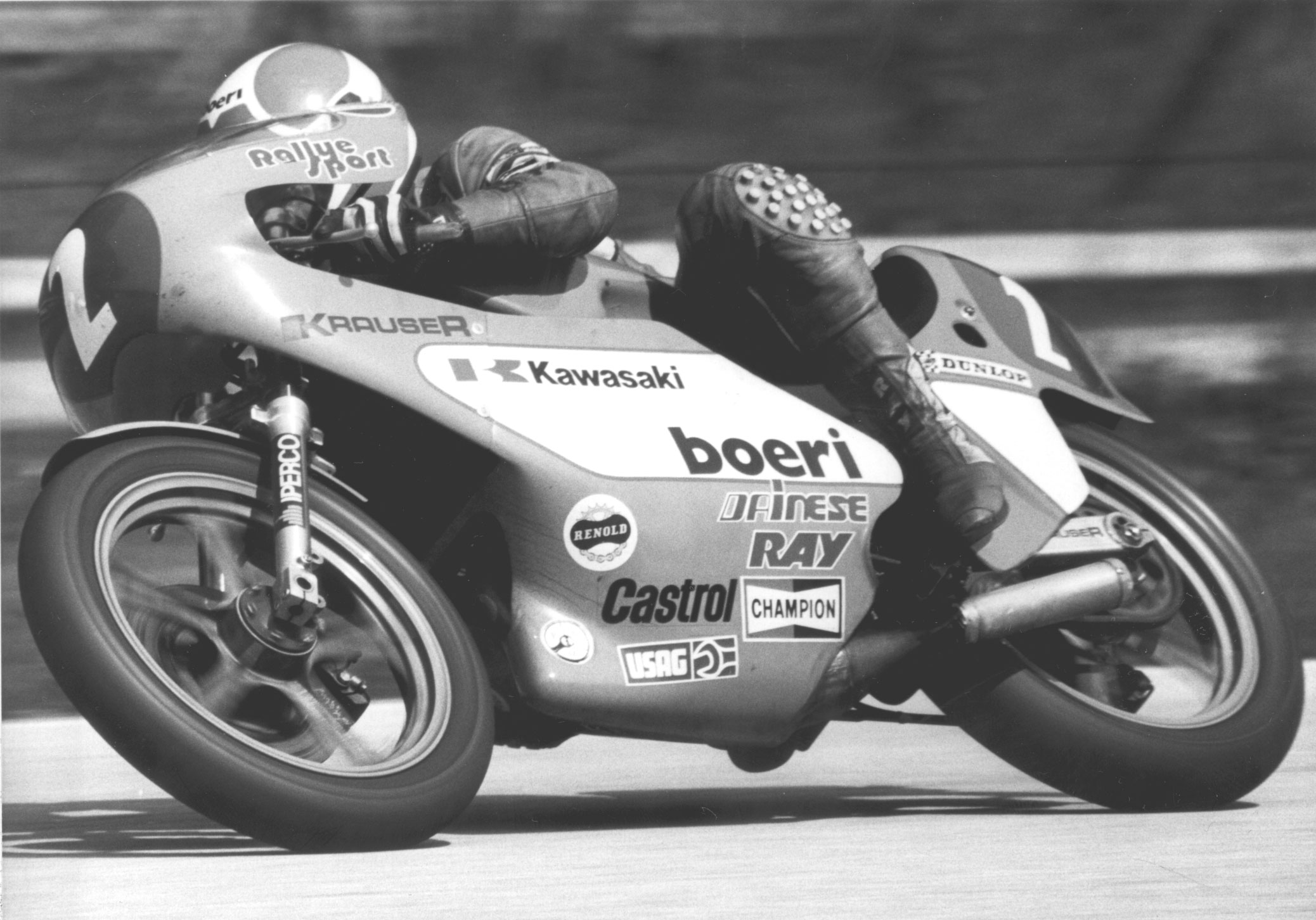
Photos FIM Archives - Caption from top to bottom:
-1 Mang, 1981
-2 Olsen, Penhall, Wembley, 1981
-3 Roberts, Spenser, Sheene (Argentina), 1982
-4 Thierry Michaud (FRA)
-5 Muller - Longtrack, 1984