1940 – 1945: Speedway Races for the Red Cross
* In the archives of the British ACU there is mention of a commission meeting held on 2 May 1940: this commission believed that it was unfeasible, or even impossible, at this time to develop the details for a new constitution to control speedway after the war, but it was willing to grant financial independence to the “Speedway Control Board” and suggested that a draft constitution prepared by the secretary general should serve as the basis for discussions when the appropriate time arose.
* Speedway events were organised in several places to help the Red Cross but most of the activities in Great Britain soon ended – which had been doubtless the case on the Continent for a long time.
* The next ACU meeting was held on 19 June 1945 and the FICM on 11 June 1946.
1946: The Aftermath of the War
* Geneva, Hotel des Bergues on 11 June 1946. Hostilities had been over for barely a year and normal activities were resumed. The Union Motocycliste Suisse had sent invitation letters to all the FICM member associations. That morning the first meeting took place among the board behind closed doors: Count Bonacossa, Messrs Haecker, Pérouse and Ball as well as Mr Loughborough. During the meeting, it was decided to recommend to the council that, taking into account the international situation, all elections would be for a mandate of one year.
* The plenary session began in the presence of delegates representing 14 countries: Belgium, Czechoslovakia, France, Ireland, Italy, the Netherlands, Poland, Spain and Switzerland. The four Scandinavian countries were represented by proxy.
* The meeting began with a review of the situation of clubs and federations who had submitted information: Brazil, the British Empire, Czechoslovakia, Denmark, Finland, France, Ireland, Italy, Luxembourg, the Netherlands, Norway, Poland, Spain, Sweden, Switzerland and Yugoslavia. No information had been received from Argentina, Chile, Estonia, Greece, Hungary, Latvia, Lithuania, Portugal, Romania and the Dutch Indies. A large part of the world was not yet represented at the FICM, in particular Russia, North America and Asia.
* The possible re-admittance to the FICM of Germany, Luxembourg, Hungary and Austria, was discussed. The case of Germany and Austria were deferred, as depending on the international decisions. The Motor Union du Grand Duché de Luxembourg was re-admitted.
* The next item was the election of board members for a year. All the posts were considered to be vacant. Count Bonacossa stated that he would no longer be a candidate for the presidency. After some discussions, Mr Augustin Pérouse was unanimously elected. The vice presidents, Messrs Löfström, Ball, Haecker and Major Watling were also elected for a year, as was Mr Marians as treasurer and Mr Loughborough – also after much discussion – as secretary general.
* The CSI met the following day. The first point of discussion was the Six Day event which had taken place at the end of August 1939 in the Salzburg region. The decision was taken to consider this event null and void and removed from the records. The secretary pointed out that the FICM had not been able to recover any Six Days trophy, including the International Trophy.
* The next meeting of the International Sporting Committee was held in Paris at the Automobile Club de France, Place de la Concorde on 28 and 29 November. The agenda was impressive. Mr Nortier took the role of president with vice president Mr Lenfranc at his side.
* It was unanimously decided to award the 1947 FICM European GP to Switzerland (Swiss Grand Prix, Bremgarten, 7 and 8 June) and the 1948 GP to Ireland (Ulster Grand Prix). The commission then unanimously decided that “it would be premature to re-establish the European Championships”.
* After a long discussion, the Six International Days were awarded to Czechoslovakia. Then the issue of fuel arose again. According to the report, this was the longest discussion. It was decided for 1947 only, that fuel should contain between 70 and 75 octanes, that it should be supplied by the promoters and be of identical quality for all competitors. It should be alcohol free and have the exact composition mentioned in the regulations. Compressors were banned (for the moment only in 1947 - compressors were mounted on Italian and German engines, but no British motorcycle, the AJS engine never worked properly).
* The next point on the agenda was the “International Cross-Country race”. Mr Lenfranc explained that recently in Holland a Cross-Country trophy had been organised between riders from Belgium, Holland and England and had been very successful. Both Belgium and Holland were requesting the FICM to give its approval to this event and give its agreement that a Cross-Country event should be organised every year by Holland, Belgium and England on a rotation basis. These three countries might see their numbers increase in years to come. Cross-Country rules should be drawn up. The Motocross des Nations was on its way.
* The plenary session began on 30 November at 14h30 with Mr Pérouse in the chair. The following countries were present or represented: Argentina, Belgium, Canada, Denmark, British Empire, Czechoslovakia, Finland, France, Ireland, Italy, Luxembourg, the Netherlands, Norway, Poland, Spain, Switzerland and Sweden.
* The main issue was the re-admittance of Austria, but the matter was postponed. Canada however was admitted as a new member with the consent of the ACU.
1947: Modern Times
* The spring congress took place in San Remo. Those present were President Pérouse, vice presidents Haecker, Ball and Watling and representatives from 15 countries. The congress structure had changed since the meeting in Geneva and this reorganisation would gain in importance with the growth of FICM activities.
* Commenting upon the minutes of the previous congress, discussions turned to the voting system. Secretary general Loughborough had alluded to English law which provoked a reaction from the Belgian delegate Mr Ickx: according to the statutes, French was the legal version! There was also a discrepancy between the two texts with “absolute majority of votes” having been translated as “a simple majority of votes” which was not the same thing. It was also necessary to know if a blank ballot slip represented an expression to vote. It was decided by 8 votes to 7 (!) that only ballot slips with a yes or no vote should be considered as having voted.
* The Six Days – due to be held in Czechoslovakia - were discussed. Count Lurani announced that the city of San Remo had offered a trophy which replaced the one that had disappeared during the Six Days in Salzburg in 1939…
* Hungary was re-admitted via the Koztarsasagi Magyar Automobilclub. There was then talk of Monaco. A correct and complete request for membership was put on hold since the delegates could not agree on the status of this request. The same problem arose for the city of Trieste (independent territory at this time). Six countries were considered to be inactive members having provided no response to correspondence. There were of course the Baltic States (Estonia, Latvia and Lithuania) which had been annexed by the USSR and also Romania, Greece and Portugal who were to be re-contacted. Argentina was now regularly represented by Spain (with the delegate none other than Don Rodil del Valle). The Dutch Indies were being reorganised as was Yugoslavia. A request for re-admittance from Germany was placed on hold.
* The role of the international motorcycle touring commission was difficult in these post-war years. There was practically no tourist activity. The commission was therefore on standby. A revision of the statutes was planned.
* Next on the agenda were the elections. The Swiss Marcel Haecker was elected president with 13 votes out of 16, for the years 1947, 48 and 49. Messrs Ball, Groutars, Löfström, Pérouse and Rechziegel were elected vice presidents. Major Watling was elected treasurer and Mr Loughborough was re-elected secretary general. Count Bonacossa was thanked and praised for his long activity and elected honorary president.
* In the autumn, the congress took place again in Paris at the Automobile Club de France, together with the rapporteur / interpreter Mr Jacques Ickx (who this time, was therefore not the Belgian delegate).
* The first subject for discussion was the way votes were counted: were blank ballot slips to be considered valid? This could encourage obstructions and prevent a result being reached. Following a vote, it was decided only to consider yes or no votes.
* After a long exchange of views, the re-admission of Austria was accepted, as well as Monaco The Valparaiso Moto Club announced that contacts had been made with the clubs in Peru and Uruguay who would like to join the FICM. No formal request had yet been received.
*. The biggest problem at this time concerned the restriction on exchange and currency, which created a serious predicament for riders taking part in races abroad.
* Another problem concerned the development of tourism which covered the harmonisation of fuel between different countries but also the FICM representation on international bodies. The international tourism alliance had been formed by the FIA and the FIT and the question arose of the representation of motorcycling interests within this organisation.
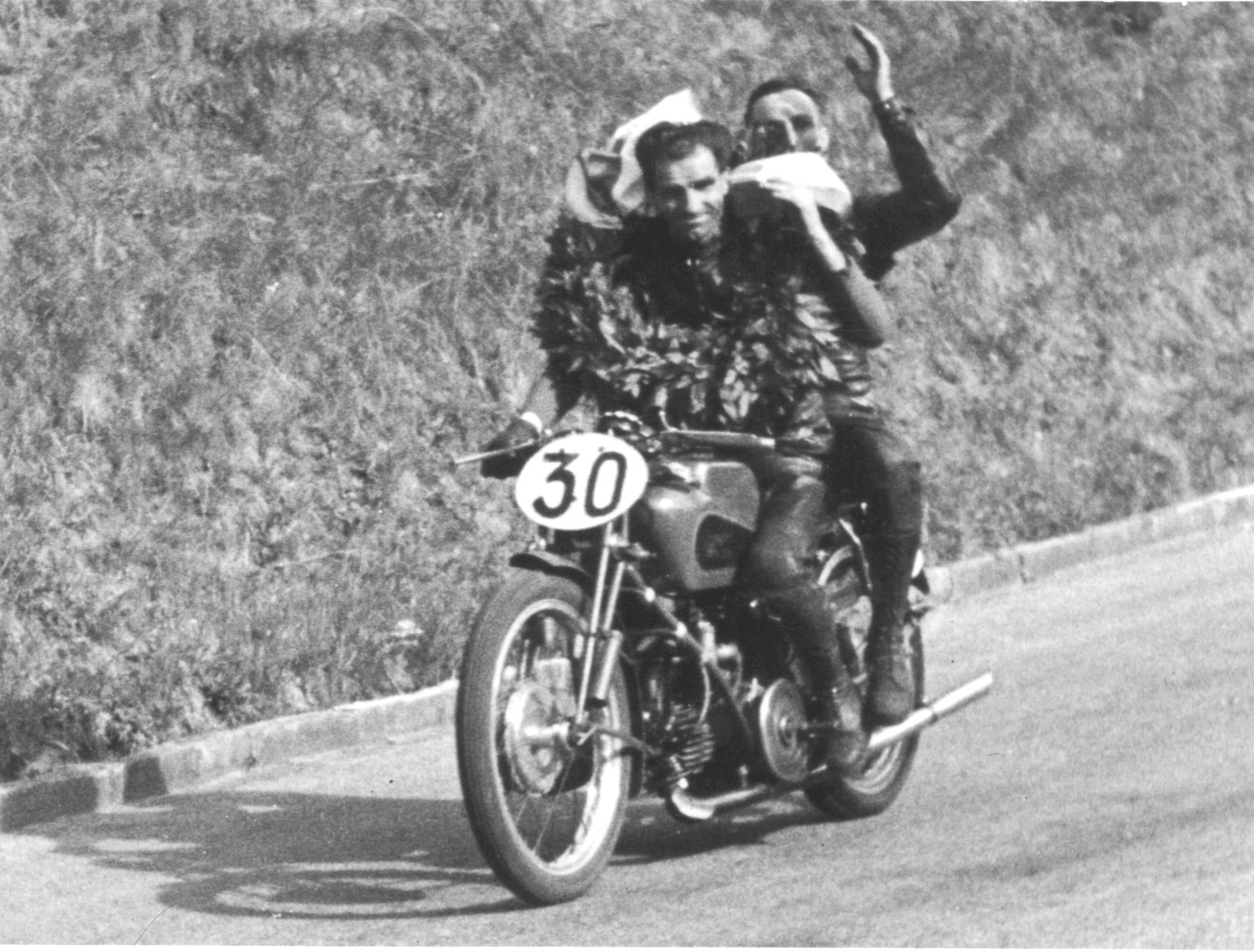
* The FICM Grand Prix, held in Bremgarten (Switzerland), was won by Italian hero Omobono Tenni, on a 500cc Guzzi. The 350cc saw the victory of British Fergus Anderson (on a Norton) while the 250cc was won by another pre-War II rider Bruno Francisci (Guzzi). A Sidecar class was again introduced which was won by Giuseppe and Paolo Cavanna on a 600cc Guzzi with an articulated sidecar (allowing the motorcycle to lean in the curves). The International Six Days were organised in Czechoslovakia – an impressive performance considering the short time since the end of the war. Both Trophy and Vase were won by the local teams.
* In the CSI meetings numerous subjects were discussed including the adaptation of the various regulations (removal of side-cars from the Six Days and increasing from four to five members per team, new classes of 50cc, 75cc and 100cc, turbo-compressors placed in a class apart). The organisation of the FICM European Grand Prix at the same time as the Swiss Automobile Grand Prix on the track at Bremgarten had highlighted the problems that this kind of joint event could produce – and led to their total separation. The motorcycles took on a minor role which meant that since the drivers had requested more practice time, practice time for the bikes was reduced. The protection of the public and the competitors was not the same with wooden barriers suitable for cars but not for motorcycles and that was only the start of it… And finally, the length of the races was lower than the minimum required by the regulations.
* “International Scramble (motorcross)” was the first mention of the term “motocross” in an FICM document. This international “scramble” was the Motocross des Nations won by the British in 1947 and enjoying great success. It was now a question of preparing the organisation of the 1948 edition.
Photos FIM Archives - Caption from top to bottom:
-1 Tenni, 1947
-2 Motocross des Nations, 1947
-3 Motocross des Nations, 1947
News
FIM History - Flash Back 1940-1947