1925: the future F.I.A. recognises the F.I.C.M.
* The Congress in Paris opened on Tuesday 21st April and was chaired by President Count Bonacossa. Thirteen countries were represented.
* The main subject to be discussed was the relationship with the International Association of Recognised Automobile Clubs, the famous AIACR, and with good reason, since a general meeting of associations linked to engine powered activities had recently taken place and the FICM had not been invited.
* The 1925 calendar had so many events that it was impossible to avoid clashes of dates. It was the first Dutch TT in Assen (the old 25 km circuit through Rolde), the first German GP on the Avus track, and the founding of a company building only electric condenser at that time: Ducati….
* The first official Grand Prix d’Europe de la FICM was held in Monza again – as the car race would be held in Spa-Francorchamps. It was decided that the title of European Champion (in each class) would go to the winner of the race. The time was not yet ripe for a series of events. A 175cc class was added, won by Italian Mario Vaga on a Maffeis Blackburne. Jimmy Porter won the 250cc riding a New Gerrard, Tazio Nuvolari the 350cc on a Bianchi, and Count Mario Revelli de Beaumont the 500cc race on a GR JAP).
* In a meeting later that year, President Bonacossa explained that following a letter sent to the AIACR, he had received an invitation from the president, Baron Zuylen to attend a meeting of the association during which the FICM was officially recognised in the general sporting regulations as the sole representative for motorcycling activities.
1926: the length of mandates increases to three years
* The first meeting was held in Geneva in March. Discussions concentrated on the Statutes, especially the change in the length of mandates for the governing bureau. Members would be elected by secret ballot for a period of three years and could be re-elected. The ban on CSI delegates having any links with a manufacturer was lifted.
* The affiliation of the Luxembourg Motor Union was accepted.
* The Grand Prix d’Europe de la FICM was held in Spa-Francorchamps. The 175cc race was won by Belgian René Milhoux on a Ready Blackburn, the 250cc by Jimmy Porter, the 350cc by Frank Longman (SAJS) and the500cc by British start Jimmy Simpson.
* A session of the International Sports Commission was held in Spa-Francorchamps, the day after the FICM Grand Prix. It was agreed to adopt a new format in two languages (French and local language) based on the AIACR version concerning licences for riders and competitors. The sub-committee on world records then convened and ratified no less than 270 new world records (22 requests were denied).
* Italian rider Pietro Gherzi was the first foreigner to enter the Tourist Trophy race, on a Moto GuzzI. He finished second but was disqualified for using a spark plug of another brand than the one on his entry form.
.* In October, on the agenda was the first secret ballot election of the Federation’s officers to serve mandates of three years until autumn 1929. For the posts of president (Bonacossa), secretary general (Loughborough) and treasurer (Sharp) there was no prospect of any surprises since there were no other candidates and as a result all were unanimously elected (14 votes). However elections for the four posts of vice president marked the first electoral «fight» within the FICM. Messrs Longuemare (France) and Neher (Switzerland), each with 12 votes, Dr Lamborelle (Belgium/eight votes) and Dr Halben (Germany/seven votes) were elected. Three delegates were not elected.
* Since it was reactivated in 1920, the development of the FICM was quick: the number of member associations had more than doubled, committees had been created and general stability had led to elections every three years rather than every year. This 3-year length of mandate would remain until 1998!
1927: Argentina – the first South American member
* On 12th April, the delegates gathered at the town hall in Milan. Count Albert Bonacossa chaired the meeting. Membership applications from Poland and Romania were complete and the two associations were accepted as members of the FICM. Concerning the United States, the secretary general explained that he had invited the American Motorcycle Association (AMA) to apply for membership, but that the AMA had replied that it was not in a position to do so. According to Mr Loughborough, there had not been time to ask for an explanation...
* The International Sporting Committee met next on 31st October at the Royal Automobile Club with representatives from the national motorcycling unions of Austria, Denmark, the British Empire, France, Germany, the Netherlands, Italy and Switzerland.
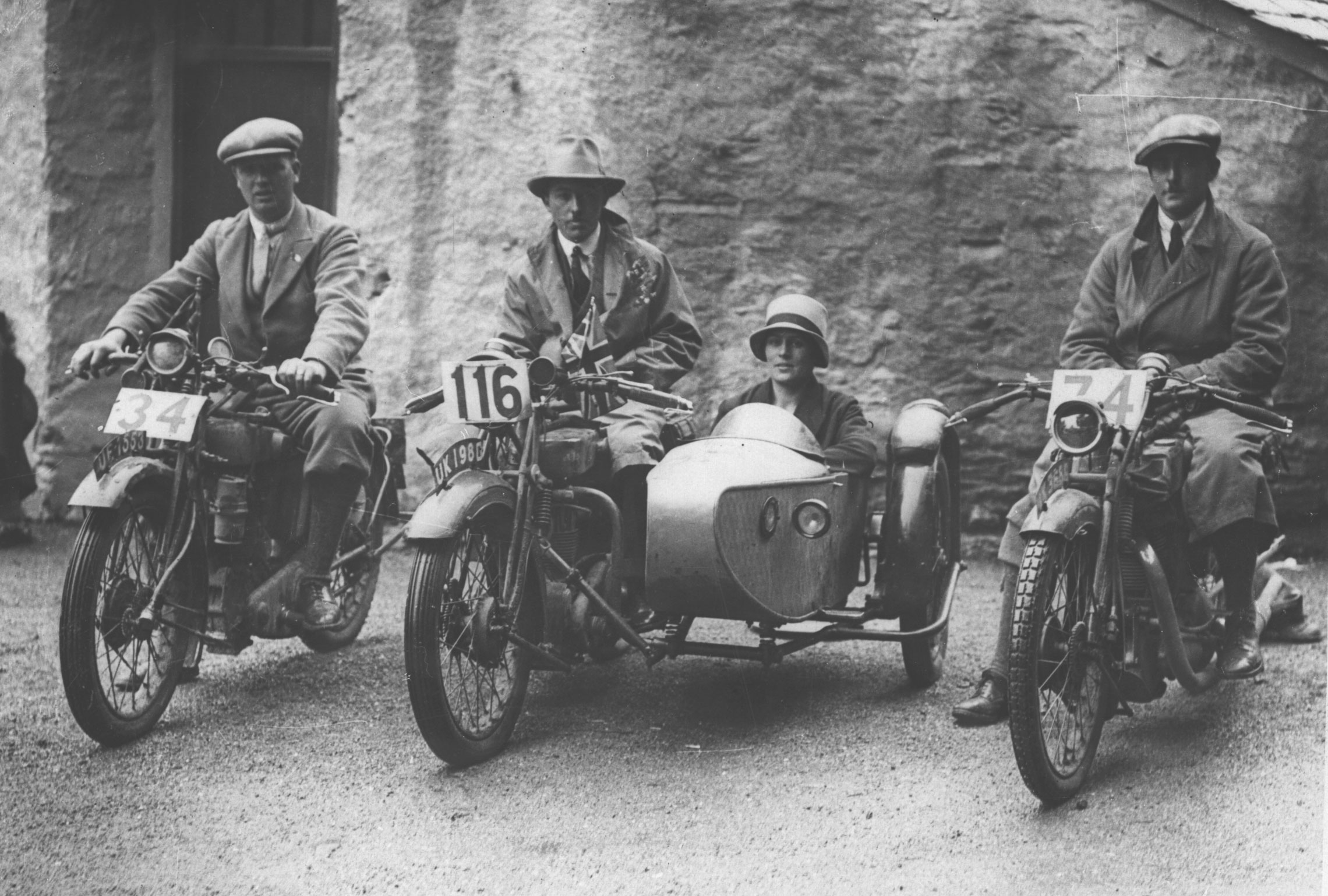
* A report on the FICM Grand Prix was presented: the race was held on the Nürburgring. The winners were respectively Paul Henkelmann (Germany-DKW in the175cc), Cecil T. Ashby GBR-OK Supreme JAP in the 250cc), Jimmy Simpson (AJS in the 350cc) and Graham Walker (Sunbeam, in the 500cc). Two classes were added to the programme: the 750cc, won by German Josef Stelzer on BMW) and 1000cc (won by Sepp Giggenbach on a Bayerland JAP) – both had only German riders competing. The Six Days of Regularity, held in Ambleside (GBR) were won by the British team. Worth to be noted is that the Silver Vase was won by a British team of Women: Marjorie Cottle, Edyth Foley and Louise McLean.
* The Dutch suggested that the number of teams taking part in the silver vase should be limited to one per country since the absence of such a rule favoured the host nation. After discussion the limit was set at two teams on the understanding that this rule could be reviewed from year to year.
* On the following day, affiliations were discussed. Argentina had fulfilled the conditions for membership during the Tourist Trophy. The president stated that he had often had contact with the Moto Club Argentino and that membership of a South American country would endow the FICM with a truly international status. The application from Ireland was also accepted according to the article in the statutes authorising direct representation for a dependency, a dominion, a protectorate, or a colony, providing the agreement of the association for the country concerned, in this case the ACU, had been received. The ACU representative confirmed that the MCUI had existed since 1902 which was in fact prior to the formation of the ACC. Another candidate – Portugal – had sent a letter from the Automovel Club of Portugal which confirmed official recognition of the Moto Club of Portugal and was therefore accepted. This brought the number of members to 22: Argentina, Austria, Belgium, Czechoslovakia, Denmark, Finland, France, Germany, Great Britain, the Netherlands, Hungary, Ireland, Italy, Luxembourg, Norway, Poland, Portugal, Romania, Spain, Sweden, Switzerland and Yugoslavia.
* The sub-committee for world records presented its report which mentioned that 229 new world records had been ratified (and 4 refused) including 159 set in Great Britain, 44 in France, 11 in Italy, 10 in Germany and five in Belgium.
1928: Speedway…
* The English delegate explained at the first meeting of that year, that a new kind of activity was gaining in popularity in England. It was held on cinder or “grass trails” in the form of duels and seemed ideally suited to some kind of commercial exploitation. In fact, on the previous 19 February in High Beech near London, the very first Speedway event was organised in England. First held in Australia in 1923, organized by a man called Johnny Hoskins, this competition attracted the attention of the ACU; who had therefore decided to take special steps to control this sport and “the ACU offered the services and experiences in this context to any other member of the FICM”.
* The meeting in Paris was held in the ACF on 2 November for the International Sporting Commission meeting in the morning, followed by a visit to the Montlhéry circuit in the afternoon.
* The Spanish Federation had not been present at many recent meetings since joining in 1920. But this time a representative was there in the shape of Mr Planas who had come to request that the 1929 FICM Grand Prix be held in Barcelona as part of a grand exhibition that was to be held in the city.
* The application from the Athenian Motor Cycle Club (Greece) was accepted.
* The CSI report was then reviewed. The FICM Grand Prix of Europe was held in Geneva-Meyrin, using roads that in part no longer exist, as they would cross the Geneva airport runway, built up in the 30s. There was no 750 or 1000cc class, but there were three Sidecar classes (350cc, 600cc and 1000cc, the latter having no participant at the chequered flag), and a 125cc class, won by Swiss Paul Lehmann on Moser. Cecil Ashby won the 250cc again, and British ace Wal Handley clinched the victory in the 350cc and 500cc, riding a Swiss Motosacoche MS 35 and MS50, prepared by English engineer Douglas Marchand.
* The barrier of 200 km/h had officially been broken on two wheels for the very first time. The record had been set at Arpajon by Captain Baldwin. It was suggested that a gold medal should be presented to him in recognition of his performance.
1929: priority for standard pump fuel
* The first meeting of the year took place in Paris on Tuesday 19th March to discuss the organisation of the Six Days that would run for the first time through five countries. The committee president, Mr Neher, explained that the MSC in Geneva had offered the services of the organisers of the 12 Hours Swiss Grand Prix for the speed test which would reduce the costs for this part of the event by more than two thirds.
* Following the death of Mr Sharp, it was unanimously decided to ask the Honourable Sir Arthur Stanley to accept the post of FICM treasurer. The Cycling and Motorcycling Union of Latvia was admitted as a new member.
* In Germany in September, on a motorway between Munich and Ingolstadt, rider Ernst Henne rode a special 750cc BMW, equipped with a small fuel tank, an original front fork, and especially an engine supercharged to 1.2 bar by a volumetric compressor. He reached 216,45 km/h, almost ten km/h better than the previous record established by Bert Le Vack – on a Brough Superior with a JAP 1000cc engine – during a traditional meeting in Arpajon (France).
* Some days later, it was the Black Thursday in New York, and the world entered a period of major economic crisis…
* The autumn meeting took place at the Palacio de la Prensa during the International Exhibition in Barcelona on 22nd October. The first issue concerned a letter from a different Latvian Club from the one admitted during the Berlin Congress contesting the legitimacy of the Cyclist and Motorcyclist Union. Having been consulted, the latter confirmed that it was the true representative of the sport in Latvia and that it was perfectly capable of controlling the situation in its own country. The council decided to lend its support to the club that had been admitted. This kind of situation would happen several times in the FICM/FIM history…
* According to the statutes it was time to elect the FICM governing bureau for the years 1930, 1931 and 1932: Count Albert Bonacossa (Italy), president; Mr Ewald Kroth (Germany), Dr E Lamborelle (Belgium), Mr G Longuemare (France), Baron G Tindal (Holland) and Mr C.H. Waetjen (Switzerland), vice presidents; Sir Arthur Stanley (Great Britain) honorary treasurer; Mr T.W. Loughborough, secretary general.
* Among the subjects discussed, it is interesting to note that the question of limiting the use of fuel to products on sale to the general public during international events was in the first instance rejected and then accepted on principle the next day. The rules were to be drawn up during the spring Congress after each NMU had submitted a list of fuels available on open sale.
Photos FIM Archives - Caption from top to bottom:
1- ISDT, 1925
2- ISDT, 1926
3- ISDT, 1927
4- ISDT, 1928
5- ISDT, 1929
News
FIM History - Flash back 1925 -1929