
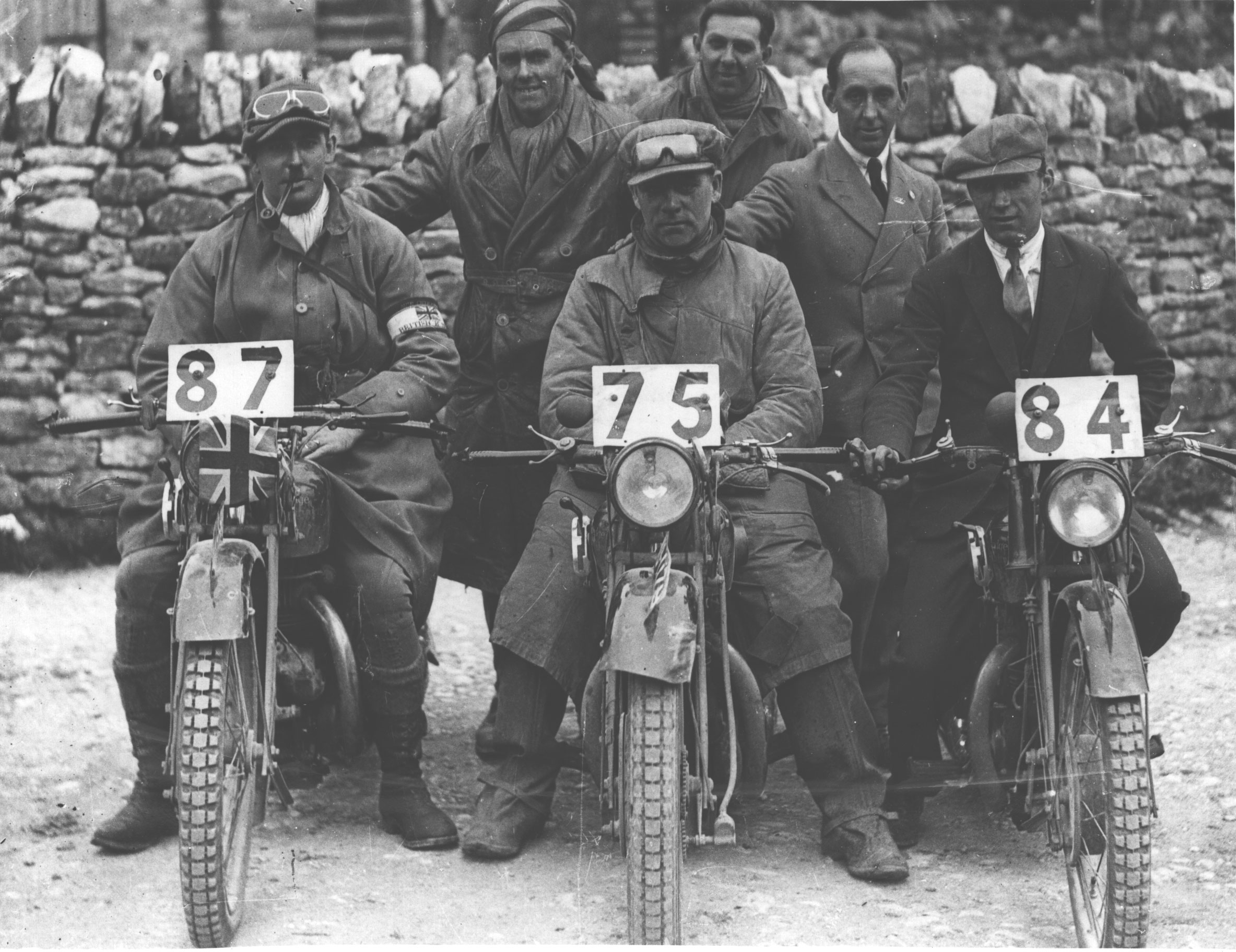
* Activities resumed in January 1920 with the first Congress after the World War I A membership request was made in early 1920 by the Motor Cycle and Allied Trades Association of the United States, who had taken over the rights and responsibilities of the Federation of American Motorcyclists
* The International Regularity event was held from 25 July to 1 August according to the same rules as planned for 1914 and at the same location near Grenoble. Fifteen riders started, three retired and twelve reached the finish to receive a gold medal. The Swiss team was the winner. The Six International Days in 1921 would then take place in Switzerland in the first fortnight of August.
* Several delegates described the conditions surrounding the recognition of world records in their country which led to an urgent need to establish an international ruling. In the event of a world record attempt over a distance equal to or less than a mile, the decision was taken to make two attempts, one in each direction over the same track. This rule is still in effect today.
* Three associations were accepted as new members of the Federation: the Belgian Motorcycling Federation (instead of the Belgian RAC), Svenska Motorcykel Klubben (Sweden) and Norsk Motorcykel Klub (Norway).
1921: first mention of a Championship
* The first 1921 Congress of the year welcomed the Real Moto Club of Spain as a new member.
* Meanwhile, in California, a rider called Otto Walker, on a factory Harley Davidson, broke the average speed record of 100 mph on the circuit at Fresno. In Italy the Circuito del Lario hosted its first race, as well as the famous Targa Florio in Sicily. In Germany the trend was more towards speed records. The famous Avus circuit near Berlin was under construction, with two straights of 8 km each!
* Count Bonacossa suggested that space should be provided on the back of the «Racers’ Registration Certificates» (the licences of the time) where the names of the races in which they had taken part during the document’s validity could be recorded.
* The question of recognition of the Federation was raised: a request must be sent to the Automobile Club in each country represented by the Federation concerning cases of discord or difficulties pertaining to motorcycling. Each Automobile Club would be requested to recognise the FICM as the international body empowered to act as last resort in such cases.
1922: helmets become compulsory!
* The Six Days of Regularity took place again in Switzerland in 1922, after their second victory in 1921. The daily route was around 300 km divided into two separate stages by a one and a half-hour lunch break. So the total distance covered was 1800 km. Results were based on the regularity of each rider and determined by fixed and secret controls. Additional tests were also taken into account such as a hill climb and a speed test from a rolling start over one kilometre for which a minimum speed was determined according to the engine capacity. The Swiss team took its third win.
* In Spain, a dispute between Madrid and Barcelona had come up. No letter had been received pertaining to the settling of the situation between the Royal Federation of Spain and that of Catalunya. It was even suggested that they quite simply contact King Alfonso XIII and ask him to use his influence to help in forming this entity!
* A proposal was made to make the use of helmets compulsory and to ban boots with metal protection: a ruling was written to come into force on 1 January 1923. The British type of helmet was the one to be adopted. The application of this ruling in cases of mixed races (like a regularity event that included a hill climb) was left to the discretion of the countries concerned.
* At the Paris show, BMW presented a R32 without a chain: the first appearance of the “cardan”.
* Concerning the 1923 edition of the Six Days of Regularity, the Swedish and Norwegian clubs accepted the Swiss suggestion and announced they would be organising the event jointly. The Swedish delegate guaranteed that the rules would conform in every way with those of 1921 and 1922 with the exception of scrutineering at the end of the event and any penalties that might ensue.
* Mr Zegers Veeckens (Holland) suggested that a Trophy should be awarded to the best team of riders in the Six Days using motorcycles constructed outside their own countries. The proposal was accepted and the Silver Vase was instated from 1924 onwards.
1923: USA withdraw
* The Autoklub Republiky Ceskoslovenske and the Moto Club of Belgrade of Serbo-Slavia (sic) were accepted as new members of the Federation. The FICM thus extended eastwards and gained two new members, but lost one – important one – in the west, for a long time. The Motorcycle & Allied Trades Association of the United States of America announced its decision to withdraw from the Federation in a letter of resignation.
* Nine races appeared on the international calendar. At the Tourist Trophy, 163 entries were recorded, and Stanley Wood clinched the first of his ten victories with a Cotton 250. The Belgian Grand Prix was won by Freddie Dixon.
* The 1923 ISDT were won by the Swedish team, but it would take one year to confirm the results, as various instances of non-respect of the rules were the objects of protests – all of them dismissed.
* The Congress met on Monday 10 December at the Automobile Club de France, Place de la Concorde in Paris. Ten countries were represented including Finland for the first time as a candidate to join the FICM. The affiliation was accepted unanimously which was not the case for Germany.
* An important change was made at the top of the FICM. Count Albert Bonacossa was unanimously elected president and a vote of thanks was made to the Honorable Arthur Stanley for valuable services rendered to the Federation. He remained president of the Royal Automobile Club and the Auto-Cycle Union until the Second World War.
* Requests for ratification of world records were submitted to delegates notably from the Auto-Cycle Union, the Reale Moto Club d’Italia, the Union Motorcycliste of France and the Belgian Motorcycling Federation. The extension of the corners at the track at Brooklands was discussed together with the change-over of riders in long distance record attempts: from now on each rider must remain on the bike for at least two hours.
1924: The birth of a European Grand Prix
* The 1924 Congress was held on 7 October at the Automobile Club de France in Paris. The first item concerned the actual creation of the International Sports Committee (CSI, for Commission Sportive Internationale), which was accepted.
* After discussions on the choice of Federation or club representing Austria, Hungary and Germany were finally re-admitted after the end of World War I. The ADAC was Germany’s representative at the FICM, but for Austria, it was requested that the OAC and OMV reach an internal agreement as to who should be the representative. Surprisingly, eight countries voted in favour of admitting the Automobile Club of Austria (OAC) against just three votes for the OMV that had been a founding member of the FICM in 1904!
* Once again the subject was raised of a proposal for a European Championship or a European Grand Prix. It would be an event that would take place each year in a different country. Firm negotiations were immediately conducted, this time between Belgium and Italy, who were both anxious to stage the event. A final agreement was reached that the country that obtained the automobile European Grand Prix would leave the motorcycling event to the other country!
* On September 7, a first European Championship race was organised in Monza by the Reale Moto Club d’Italia. Jimmy Simpson won the 350cc race on an AJS, and Guido Mentasti won the 500 on a Moto-Guzzi. Near Paris, a speed track was built up: Monthléry.
* The 1924 Six Days were held in Belgium and saw the victory of Great Britain, which was the start of an impressive series of successive wins.
Photos FIM Archives - Caption from top to bottom:
1- ISDT, 19232- ISDT Troophy, 19203- TT programme, 19214- ISDT race, 19225- Mr. Bonacossa, 1924