
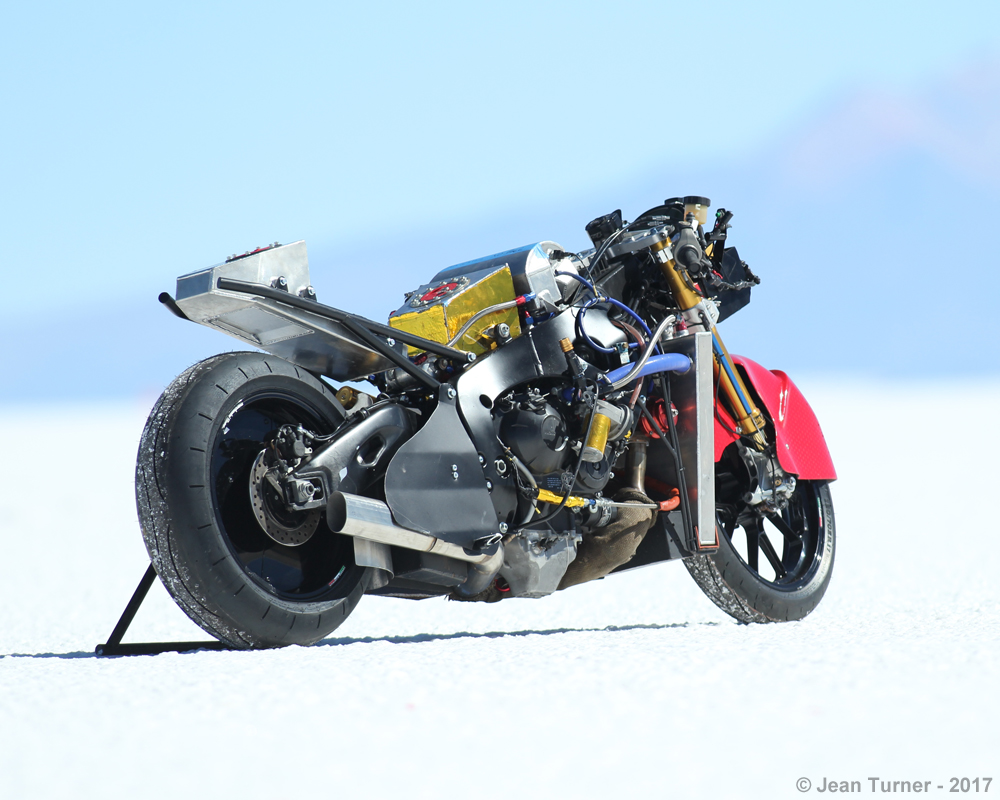
On the opening day of the 2017 Top of the World Land Speed Trial in Uyuni, Bolivia, competitor Al Lamb received some bad news. He had been eagerly awaiting the arrival of his equipment in Uyuni, which he had shipped from Houston, Texas weeks earlier. Lamb had received mixed reports of its travel—being hung up at customs in Chile, and at the Bolivian border—but he came to find out where his container actually was: still sitting on a dock in Miami, Florida. It had been seized by customs and never left the United States.
Land-speed racing is a game of uncertainty at every turn, especially in a first-ever attempt in a remote, foreign country. Land-speed racing is a test of engineering, innovation, problem solving, patience and skill. At a moment when he could have conceded defeat at a seemingly impossible logistical impasse, Al opted to look at his shipping nightmare as yet another problem to solve—just another hurdle on the road to setting a world record for the outright fastest motorcycle (non-streamlined).
In a last-ditch effort, Lamb arranged for his equipment to be airfreighted to Bolivia. But this meant leaving behind his 40-foot high-cube container stocked with a full shop and spare race bike, and packing what he could into a 5x5x8-foot cube, only his race bike and a few spare parts.
Despite the insurmountable odds, the Texan turned out to be the first to set an FIM World Record in Bolivia on the Salar de Uyuni. It was broken the next day by his friend and competitor Ralph Hudson, but Al Lamb is still striving to break the 300-mph barrier and own the record for fastest sit-on motorcycle.
This year, Al Lamb is heading back to Uyuni to once again go head-to-head with Ralph Hudson in
FIM: Tell us about your motorcycle.
Al Lamb: It’s a turbocharged Honda CBR1000RR, all Ohlins suspension, Marchesini wheels, it’s Charlie Toy bodywork from AirTech that we’ve modified, full Motec electronics on it, Garret turbo. It’ll make, at sea level, at the current setup, almost 500 horsepower at the wheel. It’s got a wrap called fast skins; it’s like a golf ball. It actually reduces drag. Over 165 [mph] is less drag, under 165 it’s more drag. But we don’t care about under 165.
You have some rather unique NASCAR-inspired technology on your bike. Explain how that works. ..
We don’t run a radiator. A radiator is one of the worst things you can have for aero [dynamics]. Air going through a radiator is about the dirtiest air you can have. So we don’t put any air through the center of the bike. With the way the front fender’s designed and the fairing, no air really goes into it. We just run a water tank and circulate. We’re cooling as we go, but we’re not cooling the water. In other words, heat synching as we go along. So we start it with the water temperature maybe 110, 115 degrees (F). By the end of the run it’s 230 degrees.
It was an original idea on our part. We use a thing they call a chiller, which the NASCAR guys use to qualify at Daytona and Talladega. They completely tape up the front, put no air through the car. So what it does is they start with water cool enough it’ll heat-synch that whole run and not be too hot at the end. Then we have a thing called a chiller that plugs on, has two quick disconnects, has a pump in it and it circulates coolant and cools the engine back off. So we get the bike hot before we run, the oil’s hot, the parts are hot, shut it off, then we chill the water back down and start with the water cool.
Last year you ran into a clearance problem on the front tire. How did you fix that for the 2018 meet?
Last time we had a tire rub issue because the tire was expanding so much [at speed]. We never had that big a problem with it before but it was expanding so much it was rubbing on the coolant tank on the front. So we were getting more than 40mm of growth per side on the tire and so it created a rub issue on the coolant tank, which is what caused the tire to come apart [on the final run in Bolivia last year]. So this year we’ve put a recess on the front of the tank, we’ve gone to longer forks and we’ve changed to a zero-growth tire.
You had a number of challenges last year, including shipping, but it seems things are already going much better this year.
We had a boost control issue when we got there last year, which, we don’t know what happened. It was fine when it went in the container but wouldn’t work when we got there. We ended up having to take an air-shifter controller and use it, which didn’t operate exactly the same way, so it took us a while to figure that out. We sorted it out and got it done, but this year we have all the bikes, all the pieces all the spares, all the pit equipment. Our tuner never made it last year. The Bolivian embassy lost his passport so he couldn’t update his visa so he never got there. And then Miami customs seized the airfreight because they didn’t like the paperwork even though it had already cleared customs in Houston. So yeah, it was a comedy of issues last year.
We went with a different shipping company this year. It left here about two and a half weeks ago. It’s been on the boat for about ten days now. So far we’re on schedule.
There are now multiple locations that host FIM World Record events, including Lake Gairdner, Australia. Why do you choose to compete in Bolivia?
I wouldn’t even consider Australia. I know it’s got good salt but also one of the benefits of Bolivia is it’s eight-percent less [aero] drag than Bonneville. Australia is almost eight percent more aero-drag than Bonneville. So why you gonna go someplace where you know the air is so dense that you know your chances of getting a record are greatly reduced? And if you look at records down there, nobody has real high-speed records down there.
It’s one thing to aim for an FIM World Record, but you have the rare case of going head-to-head with a class challenger at the same event. Describe what it’s like competing side by side with Ralph Hudson.
If all you gotta do is try to break the current record, that’s a little less tension, because you think, okay, we’ll go two miles and hour faster than we went last year and that’ll break the record. But now we both know that Ralph’s a serious competitor, he’ll go faster, we’ll go faster… I think we’ll have a pretty good head-to-head battle down there.
Competitor: Al Lamb
Hometown: Houston, Texas
Motorcycle: Turbo-charged Honda CBR1000RR (partially-streamlined)
Al Lamb's goal: to break the present FIM World Record for 'sit-on' motorcycles
Current FIM World Record: 284.361 mph / 457.635 km/h (Ralph Hudson, 2017)
FIM Communications