1970: A Propaganda film for the Olympic Games!
* The spring meetings took place in Geneva in April 1970. The new FIM office in the avenue de Champel was duly inaugurated by all the delegates. Deputy President Vorster gave a report of the AGFIS meeting which had taken place in Munich with the aim of obtaining a timeframe for presenting some motorcycle disciplines at the Olympic Games. The idea was to make a film (today we would say a video) showing motocross, trial and speedway, in particular, to “give an example of the human sporting importance of motorcycling”.
* The GP calendar for 1971 contained two new venues subject to a track inspection: the Austrian GP in Salzburg and Sweden at Anderstorp. The CSI decided to introduce the FIM Prize for 750cc sidecar motocross and seven countries had expressed interest. The system of rotation for the motocross Grand Prix for 1972, 1973 and 1974 was maintained. In track racing, in order to boost ice racing in Europe, Mr Vorster proposed to organise events on artificial ice in Innsbruck (Austria) and Grenoble (France). These events were planned for December 1970, just before Christmas.
* The autumn congress was held in Cannes (in the rooms of the Majestic Hotel) upon the invitation of the French motorcycling federation. Thirty four federations responded to the call, including seven by proxy.
* In the United States, the two associations (AMA and MICUS) had not succeeded in finding an agreement. Since the MICUS was in a difficult position, the FIM decided to accept the AMA on a temporary basis as the representative for the USA from 1 January 1971.
* At the CSI, the ages of the riders remained at minimum 18 and maximum 55. However, for countries authorising youngsters of 16 to take part in races, a special licence was introduced.
* One item on the agenda as a result of the new contacts between the FIM and the permanent board of motorcycle manufacturers was a regulation for racing production motorcycles (which was reminiscent of Count Lurani’s project on the subject of a Formula 1 production class at the end of the 50s). A report from the manufacturers would be submitted to the FIM in early 1971.
* A curious decision was then made. Riders racing a 50, 125 or 250cc machine in road races had to weigh “at least 50 kg, including ballast” (sic).
* Riders taking part in a motocross race in another class would not score any more points. At the beginning of the season, they had to choose the class in which they were competing for the world championship. There was also talk of possibly introducing an FIM Prize in 125cc motocross in 1972 according to tests held during 1971. Concerning the European observed trials championship, it was decided that it would be run according to a “normal” year from 1972 onwards. In track racing, it was proposed to promote the European championship for 100 metre sand racing to the rank of world championship (this competition had been successfully organised for 12 years). The 1971 congress was scheduled for Belfast (Northern Ireland) in October.
1971: The AMA is finally a member
* The spring meetings took place end of March in Geneva. Mr March (representative from the AMA) was invited to the board session in order to gauge the spirit of the members concerning the AMA activities in the FIM.
* It was then Mr McMaster’s (MCUI delegate) turn to be received. The autumn congress was scheduled for Belfast, but the situation in Northern Ireland was far from stable, and the board asked for more information. Mr McMaster tried to be reassuring and declared that there would be no problems. The only change concerned the hotel for the meetings which was under construction and would not be ready in time. The MCUI had therefore decided to choose another location 20 km from Belfast.
* They then began to debate the secretariat. The people hired were not satisfactory and there was no other solution according to certain members of the board than to confer the secretariat to the president with payment of a fee. Others were against this claiming that you could not ask such a sacrifice from someone (leaving his country, his family and his business). Don Rodil thanked his colleagues for their confidence and said that while he was ready to make sacrifices for the FIM he would like to find another member who could help him in this task. Mr Barambon was charged with a supervisory role while Don Rodil retained authority.
* The CSI was confronted with a regulation forbidding the change of date once the calendar had been ratified. In Austria, the Salzburgring GP had been delayed by a week due to unfinished work… like the motocross GP, but this time due to national elections.
* The CTI president, Mr Boensch, explained that the recent world record set by the American Gary Gabelich – over 1000 km/h! - could not be homologated by the FIM because the front wheels on the vehicle were more than 20cm apart. However, he suggested adapting the regulations for if the two wheels were on the same axle and turning at the same speed, it would be more logical for the vehicle to be under the jurisdiction of the FIM.
* Since the first ice racing event in Grenoble had been a big success, it was planned to organise qualifying heats for the world championship there. The decision only to use pure methanol for all international events from 1971 onwards was confirmed. There was also talk of short track races in the United States. The members of the sub-commission said they were interested in introducing this format in European events. At the technical commission, discussions focused on road racing machines. The ACU and the AMA had together developed a formula based on 750 production models. Mr March explained that in the United States, production machines were used close to FIM regulations with Grand Prix machines also close to the federation regulations and modified production machines. Some accessory manufacturers (tyres, secondary chains) had not followed the development of the heavy and powerful machines. It was therefore impossible to find a type of tyre or chain on the market which could stand the huge demands due to the enormous power developed by the large machines.
* On 25 August an extraordinary session of the central board took place in Geneva. The situation in Northern Ireland was deteriorating and several Federations were worried. The board therefore decided to postpone the organisation of a congress in Ireland to another date (which turned out to be 1993!) and to hold the annual congress in Geneva at the FIM’s own cost...
* In Geneva. President Rodil del Valle welcomed all the members for the congress: 38 countries were represented including 28 by delegation and 10 by proxy, which was an absolute record for the FIM at this stage in its history.
* The AMA was accepted definitively as the member for the United States instead of the MICUS (whose debt to the FIM it had settled). The FIM gold medal was awarded to Mr Curli an honorary member of the CSI for his work in compiling world records and revising the sporting code.
* It was then time for elections: Don Nicolas Rodil del Valle was re-elected president by acclaim. Messrs Von Essen, Ladame and Lenfranc were re-elected vice presidents. The text of the new statutes was then reviewed article by article. After a long discussion, they were approved (they would be ratified at the London congress the following year to take effect in 1973).
* Mr Dixon raised the question at the central board of appointing a press officer who would take care of relations with the purveyors of information. The president replied that he was in favour of this idea and that the question should be reviewed during the spring meetings.
* For the ISDT, the proposals were the following: the national teams for the Trophy should take part in at least three classes, with six riders (in the case of a tie, the points from the first five would be counted). National teams in the Vase should take part in two different classes with four riders (in the case of a tie, the first three would be taken into account). An updated ranking should be published every day and the final ranking was the addition of these rankings. These proposals together with some others were accepted to come into force already in 1972. The proposal for an individual ranking with the title of world champion for each class was rejected. On the other hand, the organisers could award a special prize to the best rider in each class. It was not yet the scratch (overall) ranking, but it was gradually materialising. The AMA had requested the authorisation to organise the Six Days in 1973. A lot of time had passed since Mr Wells’ proposal during the 1920s, but the Six Days were finally going outside Europe.
* The speedway world championship final crowned a rider who for the first time was neither Anglo-saxon nor Swedish; the Dane Ole Olsen. But there was another problem. The organising federation announced just a few days before the congress that one rider had used fuel containing nitromethane (laboratory documents confirmed this). The first problem was the delay in the communication of the facts. The second was that the rider ought to be punished by his own federation. Concerning the American short track, Mr Pietrczak, Polish delegate and future commission president for track racing, gave a report of his trip to the United States where he noted that this sport was not possible in Europe because huge stadiums with air conditioning did not exist (sic). But the sub-commission decided that European riders could take part in events in the United States.
* The ACU and AMA 750 formula was discussed for a long time. The CTI ended up accepting it, but it was clear that the production machines were not authorised to start with the 750cc. The Technical Commission also recommended that taking into account the power generated by these machines, the length of the races should not exceed 200 miles. The proposed formula allowed for bikes of different capacities to start together and the CSI wanted to study the matter.
1972: Olympic Games ?
* Everybody met again in April in Geneva. The accounts for 1971 were presented by the treasurer. The FIM’s financial situation was healthy as confirmed by Mr Barambon, president of the finance committee.
* Mr March, the AMA delegate, gave a report on the preparations for the 1973 Six Days which would be held from 17 to 23 September in Fort Hood, Texas. It was an open military base with a huge terrain of hills and numerous rivers.
* The 1972 Ulster Grand Prix was cancelled. It would never be organised again as a world championship event. Problems of safety, prizes, starting bonuses and the number of races per year were discussed at length, together with the selection of riders to take part in a race. The CSI welcomed the riders’ representatives – among them Dieter Braun (Germany) – and organisers. One of the problems was that the safety barriers which were compulsory for car racing but very dangerous for motorcycle races. They had to be removed wherever possible or at least properly covered. Track inspections should continue to be conducted with some of the riders as had already been the case for several years now. The key players believed that an event should not be retained purely because it had existed for a number of years (the TT was from then on in the firing line). They then discussed straw bales and synthetic mousse cushions. An inspection committee would visit the venue two days before an event to check that everything was correct and to initiate modifications if necessary. The riders were then requested to regularly inform the FIM of any problems they encountered. Concerning the number of GPs, it was difficult to reduce it since it would go against the development of racing. On the other hand a better geographical distribution would make travelling easier and reduce rider fatigue. Commitments had to be better delivered both from the organisers point of view (payment of bonuses, sanitary facilities in the paddock, security in the paddock at night) and from the riders’ standpoint (respect of entry deadlines). Concerning the formula 750 international races, they were authorised from 1972 onwards.
* An FIM Prize would be organised in 1973 for 125cc motocross. It was decided to apply a maximum age limit of 25. Events would be run along the same lines as 250 and 500. It was proposed to award points in both races of each GP of each class and not only to add the two races together. The minimum weight for cross machines was finally set as follows: 125cc – 80 kg; 250cc – 88 kg; 500cc – 95 kg. The use of titanium in the construction of the frame, the fork, the swinging arm, the handlebars or wheel axles was forbidden.
* The regulations for the Formula 750 were drawn up. As was to be expected, the major problem was the tyres which sometimes reached temperatures of 150 degrees in Daytona while the reasonable maximum limit was only 120! The American delegates explained the peculiarities of Daytona and stated that the tyre manufacturers were working tirelessly to resolve the problem. The specifications of the 750 machines were the following: mass production, on public sale, homologation of manufacturers or the dealers from their respective FMN. A minimum of 200 units had to be produced or placed on sale through ordinary commercial outlets. The following characteristics could not be modified: type of engine, number of cylinders, piston play, capacity (four strokes), alloy and the number of lights (two strokes), alloy and shapes of the sumps, cylinder head and gear box, operating system of intake and exhaust, type of primary transmission and number of gears.
* The autumn congress was held in London. Thirty five federations were represented by their delegation or by proxy. Don Rodil del Valle presided over the sessions. Mr Vorster was re-elected Deputy President by acclaim. The treasurer presented his report on the 1973 budget. Mr Boensch, president of the Technical Commission, emphasised the problems the FIM had to face concerning exhaust fumes, vehicle noise, etc. Permanent contact had to be maintained with governments and constructors to ensure that the sport was not banned in the long term.
* An AGFIS meeting had been held in Lausanne; Mr Vorster said that he realised that the chances of motorcycling becoming an Olympic sport were very slim. He explained that there were two types of federation at the IOC: those that took part in the games and those that played a passive role in the Olympic movement. During each games, two new disciplines could make demonstrations and it would be good to try and be one of them for 1980. The replacing of horses with motorcycling had been raised but rejected...
* The appointment of a press officer was still on the agenda. A working group was formed to present a central board proposal during the spring meetings. The idea of inverting the spring meetings and congress was rejected. The central board decided finally to authorise advertising on rider clothing and machines “under the control of the FMN”. The secretariat problems continued without a solution and Don Rodil was beginning to get angry because he often heard remarks insinuating he wanted to control everything himself (sic). On a more serious note, the secretariat had to be given a stable and long term structure.
* The international sporting commission accepted to reduce the length of races other than 50cc. They had to last a minimum of 45 minutes. Then it was announced that the rider Dave Simmonds had died in the explosion in his caravan on Sunday 22 October in Paris. The CSI paid tribute to him. A limitation to 12 GPs was accepted and it was the German and Ulster GPs that were dropped. It only remained to define the rules for 350cc and 500cc classes which was done: four cylinders and maximum six gears. Machines of more than four cylinders and/or six gears would be authorised as long as at least 200 units had been produced.
* According to a British newspaper, the Italian federation had requested that the TT should be cancelled. In the name of his federation, the FMI representative informed the CSI that this was not true and that the FMI had never taken such a stance. Mr Dixon took the opportunity to explain that measures had already been taken to improve safety at the TT. The Isle of Man authorities were prepared to devote large sums of money to improving the circuit. The proposal to award championship points in each heat of a motocross GP was accepted. For the 125 motocross FIM prize, the following system was provisionally proposed: two groups of riders would each take part in 8 races then the best 15 from each group would meet in the final at the end of the season.
* The inspection of a reliability trial in the United States had considered it excellent and the Six Days were definitively awarded to the AMA. The venue had changed once more. After Tennessee and Texas, it was now the turn of Berkshire (Massachusetts).
1973: New Commissions
* The central board met in Geneva on 9 April 1973. The first problem was that the flat on Avenue de Champel was already too small and it was becoming urgent to invest in larger premises which the surplus revenue from the previous year would allow without too much difficulty. Mr McMaster, the Irish delegate, would act as press officer until the Madrid meeting.
* Don Rodil announced that he had gone to the IOC headquarters on 6 April in Lausanne in order to present an official application as an international federation governing motorcycling racing and tourism activities throughout the world.
* The question of elections for the next congress was studied closely. The number of vice presidents would be reduced from nine to seven and the number of delegates was obviously going to increase, taking into account the large number of commissions. It was decided that all FIM delegates (except the president and the treasurer) would be put forward for re-election. On an exceptional basis and with a view to simplifying the division of delegates and guaranteeing that a maximum number of posts would be filled, each federation could propose two candidates per commission – just one would be elected. The length of mandates would be determined according to the number of votes obtained by each candidate (3, 2, 1 year, re-eligible).
* At the CSI meeting, the ACU requested that the FIM Prize for endurance should this year be awarded even though only three events were registered in the calendar. As the federation had already sent an official communication indicating that this title would not be awarded this year, it was not possible to reverse the decision. Concerning the FIM Prize for Formula 750, Mr March (AMA) explained that the surface of the track in Ontario had not made a long race possible since the tyres wore out too quickly. The American federation had therefore been forced to organise a race in two heats of 100 miles to conform to safety norms. The ranking had been determined by adding together the points obtained in each race (in the event of a tie, the finishing position in the second race would be the decider). After discussion this procedure was accepted by the CSI (this rule is still in force today in two heat races. The Formula 750 race scheduled for May in the United States was cancelled since according to the rules in force, no change of date was permitted after the calendar had been ratified. The request to defer until October was therefore rejected.
* The first 500 motocross GP to be held in the United States would take place in Carlsbad on 14 July. It was also decided to change the title of the controlled trial European championship to FIM Euro-American championship so that the Americans could take part. Concerning the 125 motocross FIM Prize, it was proposed to apply the same regulations as those of the 250 and 500 classes from 1974 onwards taking into account the seven best results. The formula of two groups would therefore only apply for 1973.
* The autumn congress was held in Madrid end of October. The new structure would divide the international sporting commission into three distinct entities, all independent: the commissions for road racing, for motocross and trial, and for track racing. The technical commission remained in place as did the CITM which became the CCT (commission for concentrations and tourism) and the finance committee. A promotion committee was also created. The new system would remain in place until 1998.
* The question of the press officer was discussed by the central board who decided that they should control his activities. This control would be exercised by the president of the promotion committee. The press officer could be a member of a commission and Mr McMaster was appointed for this duty until the next congress.
* For the federation’s 70th anniversary the following year, the central board proposed to publish a booklet reviewing the last 70 years with a brief history of the various racing disciplines, world records, results, officials and honorary members, as well as a summary of the history and activities of each FMN. The help of the FMNs was required.
* A discussion took place during the fourth meeting on 26 October with the riders: Dieter Braun, Kent Andersson, Klaus Enders and his passenger Rolf Engelhardt and the Dutchman Jan de Vries. Once again the minutes give no details, but it is clear that from that point onwards, there was dialogue between the riders and the FIM.
* At the motocross and trial commission, Mr René Bruneel was elected president. Reports on the motocross races in the United States and Canada as well as on the Six Days near Boston demonstrates intense activity since the AMA had become a member of the FIM.
* Mr Wladyslaw Pietrczak was unanimously elected president of the track racing commission. On the contrary to the CMT, the CCP decided that wherever possible meetings would be open to delegates from different countries.
1974: The Falta Affair
* The spring meetings took place in the rooms of the Hotel du Rhône in Geneva. Since a larger location for the secretariat was still needed, the possibility of investing some of the federation’s capital in a house, situated in Chambésy, was investigated.
* The 125 motocross championship would become a world championship from 1975 onwards. On the other hand, it was decided that side-car cross would retain its status as FIM Prize. The trial world championship should be conferred upon it at the next congress.
* The CCR conducted a thorough examination of the question of safety at the tracks. The FIM would devise a list of conditions each circuit should fulfil. A consultative committee would be formed with representatives from the CCR, the FMNs, the organisers, the manufacturers and the riders and would be charged with indicating the improvements to be made to each track before the race the following year. These improvements included the facilities and safety in the paddock. The CCR also requested that contact should be established with the FIA safety committee to discuss these questions.
* At the CMT, new regulations were under consideration for the Six Days of regularity 1975. For the first time ever, a rider under 18 had taken part in an FIM championship event. It was the first trial event in the USA (at Saddleback Park, on 6 January) in a country where the minimum age was 16. The CCR applied this limit for international trials, but not for FIM championships.
* One curious note is that the individual ice racing final at Nässjö (Sweden) had only lasted one day instead of two “because of the oil crisis”, the report says (the track racing events were run on methanol, weren’t they?)
* The problem of fuel was considered very seriously by the CT. Contact had to be made with the companies in order to be informed on the characteristics and any changes following the oil crisis, since some countries were planning to ban events (a measure based much more on propaganda rather than fuel saving). The FIM said it was prepared to work to reduce consumption but not to the detriment of the sporting aspect. The problem of the Yamaha TZ 750 which was in fact a racing model, is that it was built according to the regulations with more than 200 units produced. The CT was planning to ban it from taking part in the 750 formula in 1975.
* A new regulation was under review for endurance in order to develop the discipline. The main problem was the definition of a “sports motorcycle” and a “prototype” (sic). The minimum weight in GP for the 350 and 500 classes were added: respectively 95 kg and 100 kg which doubtless made little difference.
* The oil crisis was having virtually no effect on motorcycle tourism except in France and Italy, according to the CCT minutes. One of the problems facing the commission was the concentrations of motorcyclists not entered into the FIM calendar which were accepting foreign riders.
* The promotion committee with Mr Ladame as president discussed the following subjects: inclusion of additional information in the directory, press officer activities, FIM section in the official publications of the FMNs, launch of an FIM information bulletin aimed at the FMNs, availability and structure of the FIM card.
* The congress in San Marino took place from 19 to 26 October. Thirty eight federations were represented by their delegates or by proxy. Don Nicolas Rodil del Valle was re-elected for a fourth mandate of three years. Mr Jean Lesueur was elected vice president for three years to the position left vacant by Mr Vorster. Australia was admitted as a member of the FIM. Ecuador was also accepted as a member. The president announced the decision of the commission presidents to have periodic meetings to find an agreement on the FIM’s sporting policy.
* The central board proposed to create a medical committee in order that the riders should be in the best physical condition. Members would be appointed during the 1975 congress. The president insisted on the importance of officials being familiar with the sporting code. The central board therefore proposed to the commission presidents to organise seminars for officials. It also proposed to organise a meeting of FMNs secretaries general during the spring meetings. But it refused a proposal to divide the motocross and trial commission into two (already!) since it had not yet settled in – but it would come…
* The Formula 750 FIM Prize would have nine events and would be organised separately from GPs, with a minimum distance of 200 miles. There is mention for the first time of drugs testing. It was to be implemented for classic events. From 1975 onwards, GPs had to last a minimum of 45 minutes (except for the 50cc with 30 minutes) whatever the distance. The tracks at Brno, Imatra and Opatija would have to undergo modification work before the 1975 events.
* The case of the Swiss 250 motocross GP at Wohlen was then considered. The Soviet rider Guennady Moisseev was leading the championship but could be caught by the Czech Jaroslav Falta. Tension was at a height. During the first race, according to several witnesses, Falta was held back by slower Soviet riders (Moisseev was not amongst them). He caused a false start in the second leg and the international jury, taking into account the supplementary regulations, decided to inflict a penalty of 60 seconds which forced him back in the rankings and he lost the title to Moisseev. Article 92 of the FIM sporting code stipulated however that “the supplementary regulations must in no way modify the FIM regulations” (in the motocross world championship appendix, such a penalty is not covered), so the CMT had written to the central board to request that the “decision of the international jury should be rendered null and void and to request the international jury in future to respect the code to the letter and to issue a pardon to Jaroslav Falta for causing a false start”. At the central board, vice president Haken (the same nationality as the main party) objected, since the rider had not lodged an appeal, it was not necessary to consider the proposal. The board voted against the CMT request (7 votes, 3 abstentions). A communiqué was written to respond to this request but it does not feature in the archives…
* Finally the Technical Commission accepted to reduce the number of machines homologated for the 750 formula from 200 to 25 units. The maximum fuel tank capacity would be 24 litres. For endurance, maximum capacity would be 1000 cc and the fuel tank capacity would be also a maximum of 24 litres. The definition of a prototype at the time was as follows: “A prototype is a vehicle which must fulfil the conditions of the FIM safety code concerning the type of competition in which it is to be used”.
* The promotion committee proposed to introduce an FIM press card which would be provided to the journalists, photographers and professional reporters through the FMNs.
1975: New Safety Norms
* The spring meetings were now regularly taking place at the Hôtel du Rhône at the end of February. The inauguration of the new premises at Chambésy had taken place, but since there was still no secretary general, Don Rodil was running the secretariat.
* The central board confirmed the creation of a medical committee composed of six members, all doctors, nominated by the FMNs. A new system was discussed for the riders’ licences. Don Rodil proposed to create a Grand Prix licence, an international licence for other riders and a licence valid for just one event. There would be also licences for sporting stewards. Two new associations made their requests for associate membership: the International Permanent Circuit Association and the Latin American Motorcycling Union. The two requests remained on hold for future examination.
* At the CCR, inspections at various tracks were reviewed and a problem arose: the Tourist Trophy. A committee met behind closed doors. It was clear that on the basis of criteria in force, it would be more and more difficult to homologate the TT. During the San Marino congress, the circuit had been accepted for 1975, but the CCR could not give a promise of homologation for the following years. The aim of this was to warn organisers that homologation difficulties were standing in the foreseeable future. Some members praised the TT: its history, the significance for the Isle of Man and for the ACU, the considerable investment, and the efforts made to make the track “valid for a GP”, the safety measures and the technical value of a “true race on the road”. The increasingly numerous opponents were against the exaggerated length of the circuit, the large number of fatal accidents during the last twenty years, the refusal of the stars to take part, the presence of buildings, walls and trees near the track, the excessive total length of the races and the cost of hotels. The problem was partly a political one. Neither the CCR nor the ACU could lose face in this matter. Mr Paglia proposed that a maximum number of CCR members should go to the TT this year in order to ascertain if in fact the track could be modified to resolve the problem. A first blueprint of what would become the FIM norms for road race circuits as well as a proposal for a new scale for prizes and starting bonuses was drawn up.
* Concerning the European endurance championship, from 1976 onwards, the CCR decided that a prototype could take part in the races and a separate ranking had to be elaborated since the championship was reserved for sport production machines. GP machines were subject to the same procedure.
* At the technical commission there was talk once more of fuel consumption. Reducing consumption was a laudable intention, but there was little information concerning the real fuel consumption of the machines. A proposal to limit fuel tank capacity to 10 litres for 50, 14 litres for 125, 18 litres for 250 and 24 litres for over 250cc (with an extra litre for two strokes) was put forward. They then discussed tyres, since slicks had begun to appear in the United States. The commission declared that on the other side of the Atlantic, atmospheric conditions were generally good. However they were much more variable in Europe and this type of tyre was not really useable on a wet road (!!!).
* At the CCT it was noted that the ban from the French government on motorcycle gatherings due to the oil crisis had not yet been lifted which of course posed a problem, since the organisers advertised abroad and the FIM could not authorise these events.
* The congress was held in West Berlin from 25 October until 1 November at the Hotel Kempinski. In actual fact, the list of those present mentions thirty nine federations in West Berlin for this congress. According to the rotation of the mandates, there were four posts of vice president to be decided. Mr Ed Youngblood (AMA) became the first American to be elected FIM vice president and he would remain so until the 1996 Bangkok congress. Columbia and Malta were accepted as new members. Mr Andrea Ippolito, father of the current FIM president, Vito Ippolito, explained that the main aim of the Latin American Motorcycle Union was to develop motorcycle sport in these countries.
* At the CCR, new regulations were drawn up containing minimum standards for GP circuits and indispensable safety measures. The standards would come into force for 1976. Some were currently only recommended at this stage such as the length of the track (between 4 and 10 km), the width (minimum 8 metres), the obligation to provide recent tracks with a service road, permanent facilities with hot and cold water, as well as showers and toilets in the riders’ paddock. Demands starting from 1976 included: starting grid on a straight at least 250 metres long and 12 metres wide, entry and exit from pit lane, longitudinal profile of the track, surface covered by granulated asphalt with good adherence and no aquaplaning, good water drainage, edge of the track and all signage marked with anti-slip paint. Average speed should not surpass 200 km/h (the use of chicanes would therefore be necessary on some tracks), positioning of stewards’ posts, radio contact between the race director and the posts, medical service and the first aid services. The safety measures were outlined with protection netting on the corners and, if there were no obstacle a run-off area had to be foreseen. Concerning rider entries, the first 15 in the ranking from the previous year and the first 5 in the current year’s ranking had the priority for entry. The federations had to send their “grading list” for riders to the CCR. For the rider rankings, the 1976 season would be divided into two parts, with a minimum of the best results from each half counting for the championship. For the constructors, they had to hold either an A or a B licence. The points in each race would be those of the first rider riding a bike of that make.
* An analysis of the 1975 results by the CCP showed a clear increase in the number of spectators as well as television coverage. The speedway final in Norden (Germany) had been broadcast by six television channels including one in Spain and one in Turkey. Two seminars had been organised and others were to follow. The CCP also drew up the regulations concerning tracks and safety measures in all disciplines: speedway, ice racing, grass racing and sand tracks.
* The Technical Commission also discussed noise control, fuel consumption and slicks. The problem remained riding on a wet track. The representatives from tyre factories agreed that the enormous power of modern racing machines could not be harnessed safely with normal tyres on a wet track. On the other hand, a slick tyre had no chance of becoming the production tyre for standard models in the future. Finally, the commission decided to continue to authorise the use of slicks for 1976 with certain conditions: they were only allowed for international races in 350, 500 and 750 cc and banned for endurance. Two hours before the start, the race director had to ensure that the weather was fine (sic) to admit the use of slicks. He had to ask the opinion of the tyre manufacturers’ delegate and the rider representative. In the case of rain during the race, the race director had to stop the riders on machines equipped with slicks (according to a list provided at the start). Tyre manufacturers were obliged to offer and to sell slicks to all competitors at an event.
Photos FIM Archives - Caption from top to bottom:
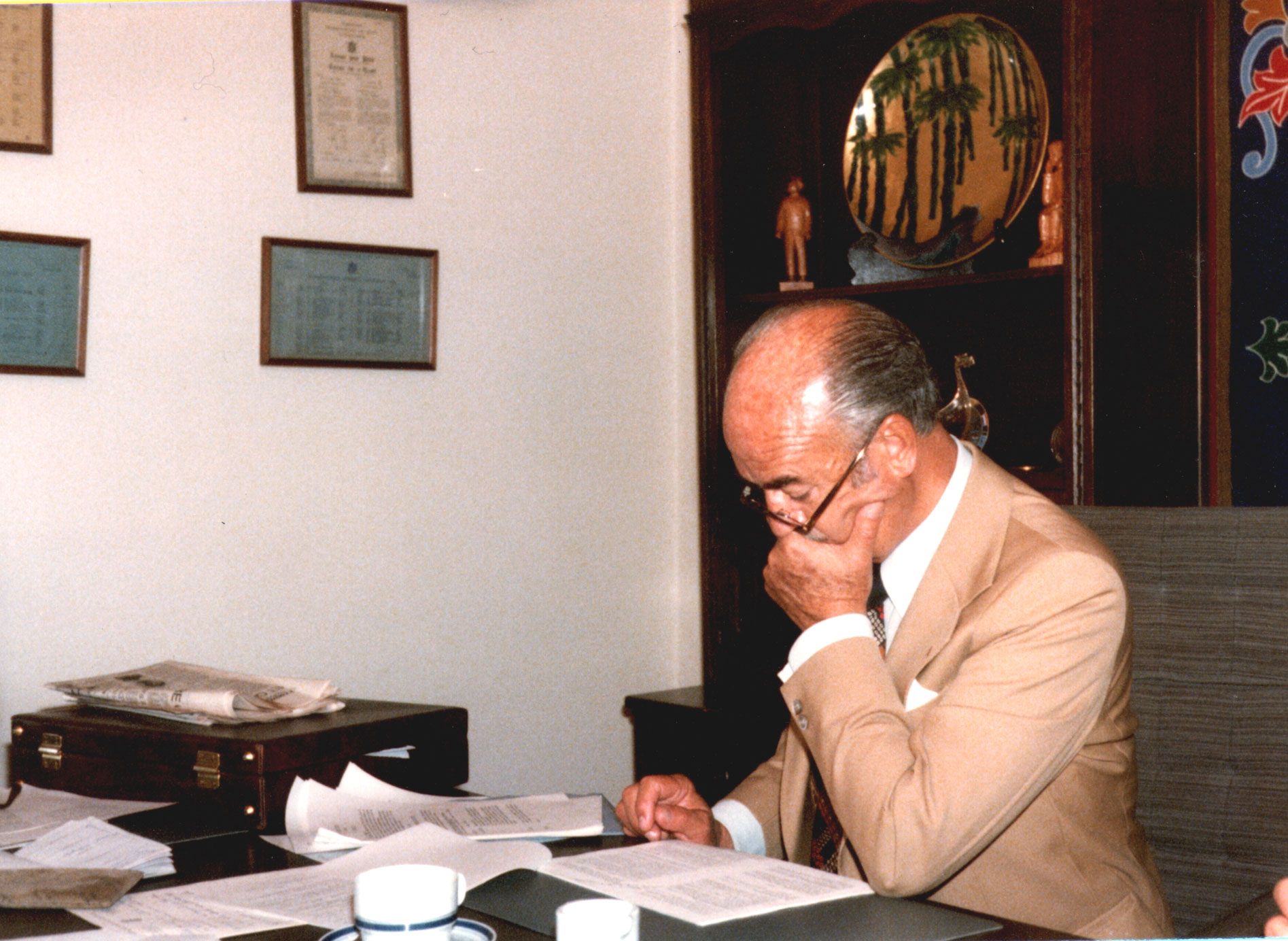
-1 Don Rodil del Valle, FIM President, 1970
-2 Nieto Braun Sheene - Spanish GP 125, 1970
-3 Jarno Saarinen, 1971
-4 Don Rodil - Giacomo Agostini, 1972
-5 Spanish GP 250, 1974
-6 Eugenio Lazzarini, 1975
-7 Walter Villa, 1975
News
FIM History - Flash Back 1970-1975