
The exemplary work of FIM Africa – one of the FIM’s six Continental Unions (CONU) – comes under the FIM Sustainability Week spotlight today – Wednesday 3 June – when the focus shifts to the launch of the 2026 FIM Africa Sustainability Campaign for Motorcycling in Africa.
With the theme of ‘Ride Sustainably. Build Resistance. Regenerate Africa’, the campaign by FIM Africa aims to establish African motorcycling as a sustainable, resilient and regenerative sporting and leisure touring ecosystem. To achieve this goal, attention must be paid to reducing environmental impact, strengthening operational systems, building adaptive event structures and creating positive, long-term community and environmental legacy.
A five-point framework has been created around the key principles of ‘reduce’, ‘reuse’, ‘recycle’, ‘resilience’ and ‘regeneration’ with the campaign’s stated mission to build stronger, more adaptable event systems capable of operating across diverse African realities while ensuring motorcycling has positive environmental, educational, social and economic impacts in every host territory.
Using the guiding principles of practical sustainability, shared responsibility, systemic resilience and positive regeneration, over the next six months the framework will be implemented with a series of monthly themes underpinned throughout by the introduction of resilience and regeneration principles through the Sustainability Commission for FIM Africa.
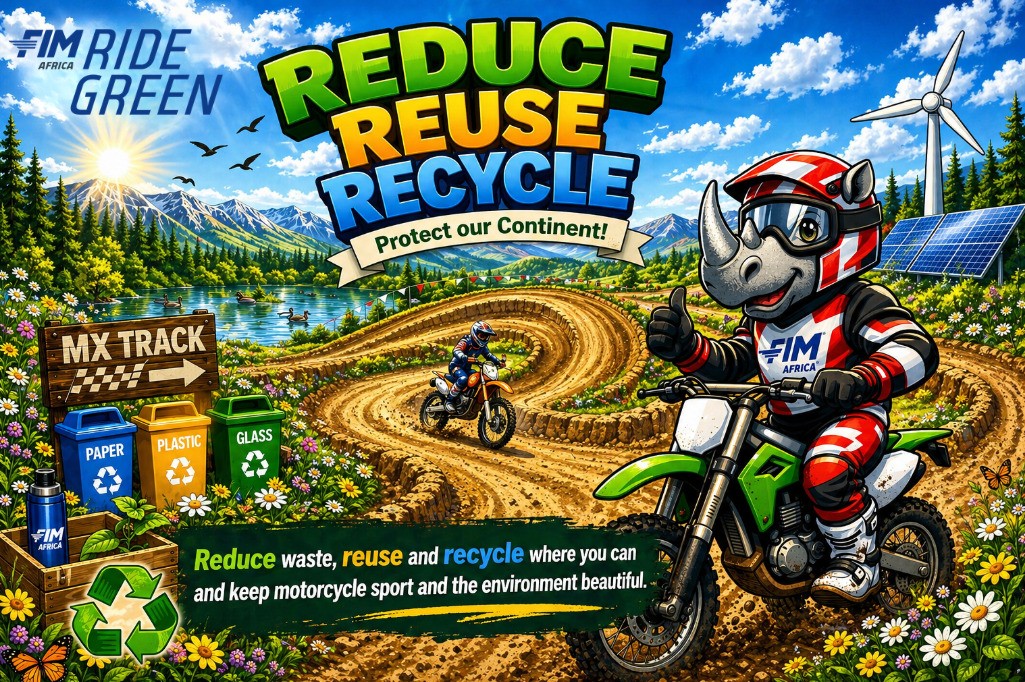
Promotional poster for FIM Africa featuring 'Ricky the Rhino', the FIM Africa mascot. The rhinoceros is emblematic of the African continent and symbolizes conservation, the protection of wildlife and natural resources. © FIM Africa
Starting with ‘Foundation and Alignment: Building the Vision for Sustainable African Motorcycling’, among this month’s key objectives will be the launch of an integrated sustainability campaign in partnership with the FIM and the announcement of 2024 FIM World Rally-Raid Champion Ross Branch as the new Sustainability Ambassador for Africa.
Month two – ‘Reduce: Reducing Impact and Building Efficiency’ – will focus on reducing consumption and unnecessary travel while simplifying infrastructure before ‘Reuse: Creating Durable and Adaptable Event/Activity Systems’ highlights month three’s key focus areas of Modular Infrastructure Reuse, Reusable Operational Systems and Shared Resource Networks.
Month four – ‘Recycle: Transforming Waste into Community Value’ – will centre on Localised Recycling Systems, Education Through Recycling and Permanent Recycling Processes before ‘Resilience and Community Engagement: Strengthening Communities Through Motorcycling’ forms the basis of month five’s focus on Community Partnerships, Rider Sustainability Ambassadors, Resilience Workshops and Regenerative Community Activities.
A month dedicated to ‘Legacy and Long-Term Implementation: Embedding Sustainability into African Motorcycling’ concludes the initial framework implementation with the key objectives of evaluating the campaign impact, institutionalising sustainability systems and establishing long-term resilience and regeneration strategies.
Marco Comana, President of FIM Africa, said: “Motorcycling in Africa is growing all the time with increasing interest in sports including Motocross, Enduro, Cross Country and Rally-Raid and this year we have established a new Circuit Racing Commission that will focus on young rider development. These are very exciting times, but it is essential that we pay very close attention to sustainability and the Sustainability Campaign for Motorcycling in Africa which provides a solid, considered framework that provides all our activities with practical guidelines to follow.”
Kattia Juàrez Dubón, FIM Sustainability Commission (CID) Director, added: “The importance of the FIM CONUs’ roles in achieving our sustainability goals cannot be understated so I am delighted to see how FIM Africa is building its strategy with a focus on resilience and restoration. This is a very practical, forward-thinking approach to a vitally important subject and – with the full support of the FIM Sustainability Commission – I feel confident that this integrated vision will allow us to take great steps towards building a sustainable future across all activities in Africa.”
-----------------------------------------------
Full Caption for the Promotional poster:
Promotional poster for FIM Africa featuring 'Ricky the Rhino', the FIM Africa mascot. The rhinoceros is emblematic of the African continent and symbolizes conservation, the protection of wildlife and natural resources.