
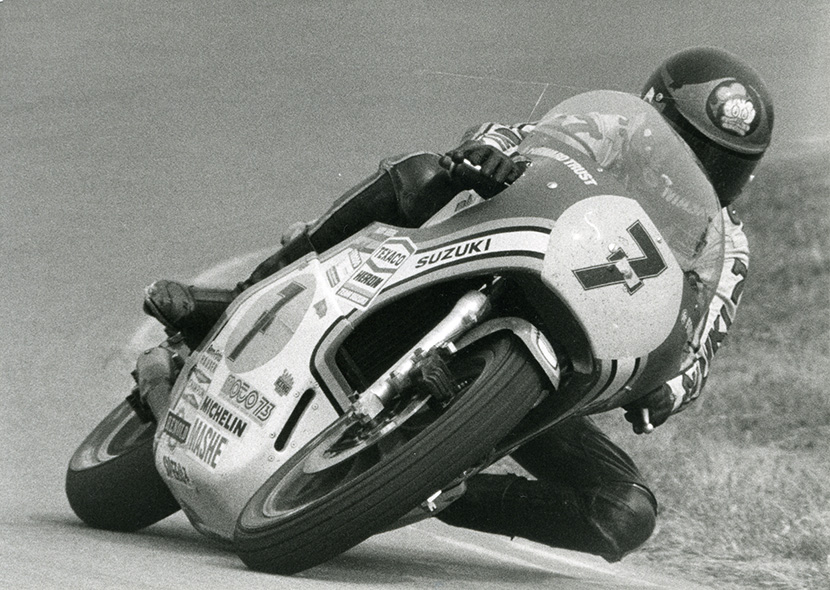
One rider made a particularly strong contribution for the development of the motorcycling sport in the world of the mid-seventies, with a new approach of competition which would very soon reach a larger public and increase communication and advertising. This rider was coming from United Kingdom. Barry Steven Frank Sheene was born in London on 11 September 1950. Son of Frank Sheene – former rider and an excellent motorcycle mechanic – and Iris, he first raced in 1968 riding his father’s 125cc and 250cc Bultaco. He finished second in the 125cc British Championship in 1969, and became British Champion in 1970 riding the 1967 Suzuki twin used by Stuart Graham, also scoring his first GP points in Montjuich finishing second behind Spanish star Angel Nieto. He raced the whole 125cc GP season with the same motorcycle in 1971 and ended up in second place behind Nieto after an excellent season. In 1972 he raced in the 250cc with a Yamaha. But he crashed during practice at the 4th GP in Imola and broke a collarbone. His motorcycles were then given to Jarno Saarinen who won four races and clinched the title. In the winter period 72/73 he was hired by Suzuki to race in the newly-created F-750 FIM Prize for the 1973 season, and he won it. For 1974, Suzuki introduced the new RG 500; with it Sheene finished the season in sixth place.
Early 1975 in Daytona, Barry Sheene had his most serious crash at full speed on the banking, which could have ended his career: left thigh, right arm, collarbone and two ribs (added to three damaged vertebrae following a crash in 1972). Nevertheless he recovered within 7 weeks and was racing again in GP500 taking the RG 500 to a first win at the Dutch TT in Assen and a second one in Sweden.
1976 & 1977 were years of major success for Barry: five wins in 1976 and six in 1977 resulted in two consecutive 500cc World Titles. Success was enormous. In 1978, however, a rider came for the USA who changed the situation: Kenny Roberts. Sheene won two races and scored points in all races except one, but he finished in second, seven points behind Roberts. In 1979, Barry scored three wins (Venezuela, Sweden and France) but ended third. He then left Suzuki for Yamaha. After a first deceiving year, he received factory equipment and 1981 was a good season, in which the main fight between himself and Kenny Roberts was overshadowed by Suzuki riders Marco Lucchinelli and Randy Mamola. Barry only won one race – the last of the season and his own last victory. The 1982 season ended for him in Silverstone during an open free practice session. At high speed, while testing the V4 Yamaha he hit a fallen bike in the middle of the track. This horror crash resulted in two broken legs and a broken arm which, added to all the ones he had suffered previously, significantly reduced his riding potential. At the end of the 1984 season he retired from racing.
In the late eighties, with his wife Stephanie and their two children, they moved to Gold Coast, Australia. The main reason was that climatic conditions were much better down under for Barry’s health and comfort.
Beside property development business, Barry started to work as a TV commentator, essentially for Grand Prix racing, but also for car racing and social TV entertainment. In 2002 he was diagnosed with cancer. He refused chemical therapy and passed away on March 10, 2003 – exactly 13 years ago.
Text Marc Pétrier Photo FIM/Maurice Büla Collection